Showing posts with label birds. Show all posts

Thursday, 4 November 2021

Slightly red


The Red Wattlebird isn't as red as you might think. Here's one in the front yard today, making merry with the grevillea flowers.

Its only red bits  are its 'wattles', the dangly bits below its cheeks. They tend to be invisible unless you can get up pretty close.

Monday, 28 June 2021

Having a butchers

Back to a COVID lockdown in Sydney this week. So back to daily walks in the local parks, takeaway coffee in the car, and today a nice big slice of banana bread that was on special with the coffee.


Butcherbirds are supposed to be carnivorous, but this one got very interested in my banana bread. Or maybe he was hoping to take my eye out. I kept the window shut.

He's a grey butcher bird (Cracticus torquatus).

Wednesday, 2 June 2021

Last laugh for Aldi's toy telescope!


Checking out last week's Aldi specials, I came across their $40 'spotting scope'. Surely just a toy, I thought, at that price. But I needed a new toy, so I gave it a go and bought one. 

And you get to see owls and kookaburras, going by the pictures on the box!


No owls or koalas so far, but when I tried it out at Crosslands Reserve, a convenient kookaburra was lurking. And the pictures I got, just holding my phone camera up to the eyepiece aren't that bad at all!

Sunday, 27 December 2020

Dollarbird!

I saw him chasing insects from his perch on the power lines outside yesterday. He was very handsome, and he was completely new to me. He's a dollarbird (Eurystomus orientalis).

Somehow I'd never heard of him, let alone spotted one of his kind. 

The books and the birdo sites don't actually seem to indicate that dollarbirds are particularly rare in Sydney. Like the channel-billed cuckoo and the koel, they are summer visitors from New Guinea and Indonesia.

Sunday, 25 October 2020

Backyard birds


It's just been Backyard Bird Count Week. I did my usual 20 minutes count, and spotted all the usual rainbow lorikeets, noisy miners, sulphur crested cockatoos, etc, and a family of king parrots happened by at just the right time too.


Here's a rather over-friendly king parrot who came to visit us a few weeks ago.


And a very big family of rainbow lorikeets.


 A tawny frogmouth


And a brown cuckoo-dove I spotted nearby last week. I'd seen these before, without quite getting round to identifying them properly.

Monday, 13 July 2020

Peregrine vs pigeon

While having morning tea break the other day at Liversidge Hill in the Blue Mountains, I watched a life-and-death drama being played out. It involved a peregrine falcon (fastest bird in the world) and a very frightened rock pigeon.

Hopelessly slow and portly by comparison, and knowing it represented a very tasty meal, poor pigeon made an emergency landing under a bush very near us, and crouched in there looking every bit as terrified as it must have been. Peregrine circled and dived for quite a while. He knew it was just a matter of time.

Eventually we had to move on. We gave pigeon and his refuge a wide berth, and departed the scene. Looking back from time to time, Peregrine kept circling.

Then he dived, and we couldn't witness what eventuated. It probably wasn't pretty though.


Monday, 8 June 2020

Getting the blues to get the girls


I came across this yesterday while bushwalking in the North Rocks area. It's a satin bower bird's bower.

The male bird builds this thing, which is not a nest, but a place to do ritual dances around, and then collects blue things. He's extremely fond of blue things.


And presumably, so are the females. The more blue things he's collected and showing off, the better his chances of getting the girl.

Presumably bright blue things used to be rare and precious. Now there's lots of them and they're nearly all plastic bottle tops, straws, or suchlike. The magic must still work though.


We were wondering why blue is the chosen colour. Maybe it's the relative rarity of the colour in nature. A bit like we're often attracted to gold? There again, the male bird himself has a blue sheen, and bright blue eyes. We didn't see him yesterday, but here's a picture from the Wikipedia article.

                                          Photo: Joseph C Boone

Tuesday, 24 March 2020

Dubbo's birds

All spotted at Dubbo Zoo, though only one of them was an official exhibit.

Here's an emu.


And an apostlebird. Wikipedia tells me it's also known as a grey jumper, a lousy jack, or a cwa bird.

And the Australian white ibis. This one's widely known as the 'bin chicken', because of its passion for hanging out in and around rubbish bins, in Sydney parks and elsewhere. Some love it, but most of us do not.


Friday, 13 September 2019

More garden parrots

This one's the yellow-tailed black cockatoo. He's one of two who visited the front garden this afternoon, and crunched away on the seeds of a Banksia tree. You usually see them further west, in the mountains. I don't recall seeing them here in the northern suburbs that much before.

Here's an Australian Geographic article on the subject: Australian Geographic article

Friday, 30 August 2019

Love birds


Our Spotted Doves. They're there in the front garden most days. Very in love.

Thursday, 29 August 2019

More funny turkey business

He was either trying to build a nest mound in the middle of the road, or more likely, trying to move a whole lot of mulchy stuff from the bush on the right to someone's garden, on the left. He's nested there before, after all. And outstayed his welcome I think. The humans who also live there have been trying to chase him and his building materials back over the road.

I've posted previously on these maybe not-so-bright feathered friends. See here: Talking turkey

and here: Brushing is what we do


Here's a video of today's episode:

Sunday, 25 February 2018

Away with the birdos

I had an excellent morning excursion yesterday with the Cumberland Bird Observers' Club. We went to Crosslands Reserve, and during a three hour stroll I counted a very respectable 21 bird species.

I'm not entirely new to bird observing, but I am to the club, and appreciated leader Trevor's introductory talk, on field guides, binocular use, observer etiquette, and lots more.


Trevor has travelled the world pursuing his passion, and he knows his stuff.


We'd hardly started when somebody spotted a white-bellied sea eagle perched in a tree. Out came the binoculars and the 1000mm long lenses. (And out came my $150 Aldi camera too! It did a respectable job as ever.)
Two tawny frogmouths now. No way I'd have noticed them without the trained eyes of the old hands in the group. They look like bits of tree.


Ditto a Lewin's Honeyeater. The regulars had been hearing him and his friends for a while and recognising his call.


My day's 21-species list:
Australian Wood Duck, Noisy Miner, White-bellied Sea Eagle, White-faced Heron, Eastern Spinebill, Crimson Rosella, Australian Raven, Dusky Moorhen, Magpie-Lark, Lewin's Honeyeater, Golden Whistler, Australian Magpie, Grey Butcherbird, Masked Lapwing, Chestnut Teal, Tawny Frogmouth, Superb Lyrebird, Striated Thornbill, Brown Gerygone, Australian Brush-turkey, and Superb Fairy Wren.

Thursday, 29 December 2016

Bird books ain't bird books - and a tale of three wattlebirds


My best Christmas present this year was a new bird guide. The 2012 (ninth) edition of Pizzey's 'Birds of Australia', no less.

I already had two well thumbed, trusty books at my disposal: the 1981 Pizzey, and Simpson & Day's 'Field Guide to the Birds of Australia' (fourth edition, 1993). So why would I want another?

Well the Simpson & Day had been leading me astray with its wattlebirds. It said there was the Little Wattlebird in WA, the Yellow Wattlebird in Tas, and in Sydney it said we got the Red Wattlebird and the Brush Wattlebird. Yet I kept hearing references to Little Wattlebirds in Sydney. What was going on?


Pizzey had no Brush Wattlebirds gracing its pages. And we got the Little Wattlebird in Sydney. The big disadvantage with my old Pizzey was that the picture pages had all the birds bunched close together, and these, as well as the descriptions and the distribution maps were all in totally different sections of the book, which was a real pain.

All was revealed re the great wattlebird conundrum recently when I heard that the Brush and Little Wattlebirds had now been reclassified as the same species. There's no longer a Brush Wattlebird, and yes, it really is the Little Wattlebird here.

And pages 386 and 387 of my new Pizzey are devoted entirely to the three Australian wattlebirds. Pictures, maps, and descriptions are all there together now. All just as it should be! Good work Mr. Pizzey. (And Mr. Knight, the illustrator.)

Friday, 21 February 2014

British Birds


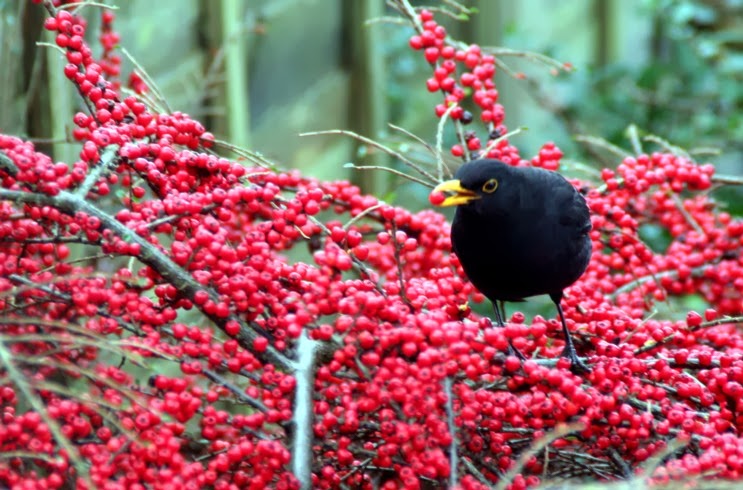
These are some of the backyard birds I grew up with in England. The Blackbird (above), the European Robin (left), and, just occasionally perhaps, a Redwing (bottom picture). The Redwing's a winter visitor to the country. It looks a lot like a Song Thrush, but has that red underwing.

Another winter visitor, apparently a much rarer one, is the Great Grey Shrike. Apparently only 50 of them visit the country every year. I don't think I've ever seen one, but I had a near brush with one during my visit last month!

In the lay-by on the Redditch Road at Hopwood as I passed by there was a big cluster of paparazzi, all with long lenses trained onto the field to the west. "Twitchers!" I said, and foolishly drove past. So no Great Grey Shrike for me. Here's an article devoted to its special beauty though: www.independent.co.uk/environment/nature/nature_studies/id-never-seen-a-great-grey-shrike-before-and-i-couldnt-get-over-its-beauty-8994035.html   

Funny, that link's no longer working for me either. Here's another one: https://www.birdguides.com/species/species.asp?sp=122072   Not as eulogistic though - but there are pictures, and there's a report of another sighting at Hopwood, Worcestershire!

Tuesday, 3 December 2013

Surviving the museum


 'Surviving Australia' is the name of one of the galleries at Sydney's Australian Museum. It's packed with scary venomous spiders and snakes, things like sharks and crocodiles that eat you, stingers, biters and buzzy things, all the things the tourists love. And so do we!

It's been 20 years or so since I'd last explored the place, and it's come on quite nicely. There's still the classic galleries with the the fine collections of stuffed birds, insects, marsupials etc. There are skeletons galore, and of course dinosaurs. Menacing, noisy dinosaurs. Australian ones too these days. There are rocks, gemstones and meteorites.

A lot of work has gone into making things very accessible and exciting for kids and for tourists.  
There's also a classy gallery on indigenous Australia, and intelligent displays on environmental degradation and extinctions.

I think an Australian Museum visit is a must for visitors with a few hours to spare and a wish to gain a good quick introduction to the country, and it should probably be on the agenda for all of us locals too now and again.