Showing posts with label photography. Show all posts

Wednesday, 14 April 2021

Photos 1440

The State Library runs lots of excellent exhibitions. One of the ones on at the moment is Photos 1440*, and it's a collection of fine works from the Sydney Morning Herald's staff photographers.

It's been quite a year for news, and for photojournalism, what with droughts, fires, floods, and a pandemic.

Here are some of the pictures relating to these and other momentous events.


* There are 1440 minutes in a day, by the way.


Wednesday, 23 December 2020

A leaf out of the mystery picture book


Here's today's mystery picture. It was on the front steps the other day.


Is it a lizard's tongue?


Is it an abandoned slice of pastrami out of someone's sandwich?


It's a very thin slice of something.


This is an interesting view


And of course it's actually just.......


........................................................


...................................this:


A gum leaf with a very water-repellent surface


Friday, 18 December 2020

Nature Photographer 2020


It's time once again for the Australian Geographic Nature Photographer of the Year competition. This year the finalists turned up at the Australian Museum. Once again they were all rather magnificent.


I particularly liked the runner-up in the animal habitat section, an out-of-focus picture of a bushfire with black kites flying around in it.


Saturday, 14 March 2020

After the fires: Maiyingu Marragu

We called in on the Maiyingu Marragu Aboriginal Area the other day, mainly to see how it had fared during the recent bushfires. It's a protected area within the larger Gardens of Stone region north of Lithgow. Most of the area is not currently protected, and should be all combined within a new national park. Not that anything would have protected it from the ferocity of those bushfires, of course.


The Gardens of Stone provides some of the finest bushwalking locations in Australia, and the prospect of not going back there could not be countenanced. Looks like we will be able to go back there, but will have to be ready to get very black and sooty.


There's a very special collection of aboriginal hand stencils on one of the rock faces. Maiyingu Marragu means 'Blackfellows Hands', which is the alternative name for the place. They're looking fine.


And there is a certain new visual drama to the scenery. I'll be back there soon.


Here's my post on our visit of three years ago:
December 2016 visit


Saturday, 31 August 2019

Starry starry night


The last few nights have been wet and overcast here in Sydney, but the previous few dozen were totally clear-sky astro-friendly ones. Here's a shot I took of the Milky Way's inner suburbs, a couple of weeks ago.

I'm still in awe of the picture quality I get from my mobile phone.

Tuesday, 7 May 2019

Photography made (too?) easy!

I got bored with my super-cheap bottom-of-the range smartphone the other day. The camera was never much good, and it was so slow that if I wanted assistance from Google Maps, I was usually at my destination before the app finally opened.

Hence the upgrade. Not my usual half-hearted minimalist upgrade, but an upgrade to a top-of-the range super-camera, attached to a supercomputer, with a phone tacked on as a bonus too.


I tested it out on a morning stroll around the suburb, pointing-and-shooting here and there. And what do you know! Whatever you shoot, it enhances, optimises, fixes up perfectly.


Most amazing of all, you can even point-and-shoot at the night sky. No need for tripod, cable release, long exposure, special lenses. Nothing. I just held it up, pointed it at the Milky Way, and pressed the button. This is what eventuated!


Here's Mount Victoria station the other day. A difficult shot, because the big shady awning was making the station and platform extremely dark, while the sunshine outside was bright. The auto-mode camera didn't blink an eye, so to speak.

And as for the super-macro lens, in use below, what can I say? This phone has four separate cameras in fact, and it automatically switches between them as required!

Wednesday, 21 September 2016

Now is the time for all good people to come to the aid of the .......... enlarged Gardens of Stone National Park


The Gardens of Stone National Park has been a bushwalking playground of mine for a few years now. It's about two hours north west of Sydney, and it's packed with unique features and wilderness values galore. It's worth World Heritage status, without a doubt.

Except that much of the relevant, precious, area is not actually protected. Not a part of the National Park. And it's mostly because of mining - coal mining in fact.

The dirty, dying, coal mining industry still goes on around here. There are longwall mine shafts under much of the area, and subsidence, pollution, and unexpected swamp drainage is going on largely unchecked.


So it's good to see there's a well organised campaign on to extend the Gardens of Stone National Park. Here's a link to the Colong Foundation's campaign: https://www.colongwilderness.org.au/campaigns/the-gardens-of-stone/about-gardens-of-stone


 The other day I attended a photographic exhibition organised as part of the campaign. I'm sure they won't mind me directing you to the photo gallery: https://www.colongwilderness.org.au/gardens-stone-focus-photographic-competition-gallery

I put in a bid to buy one of the fine pictures in their silent auction. I haven't heard back yet from them, but fingers crossed.

It reminds me a bit of Tasmania 35 years ago, when the Franklin-Lower Gordon Wild Rivers campaign was underway. Fabulous photography played a huge role, as the Australian public was educated about the unique beauty of an area which was about to be dammed and flooded by an uncaring and out-of-control government bureaucracy, for no known public benefit. That one had a happy ending. Lets hope history repeats itself here.

Sunday, 7 August 2016

A multitude of mosques, an art museum, and a photography lesson

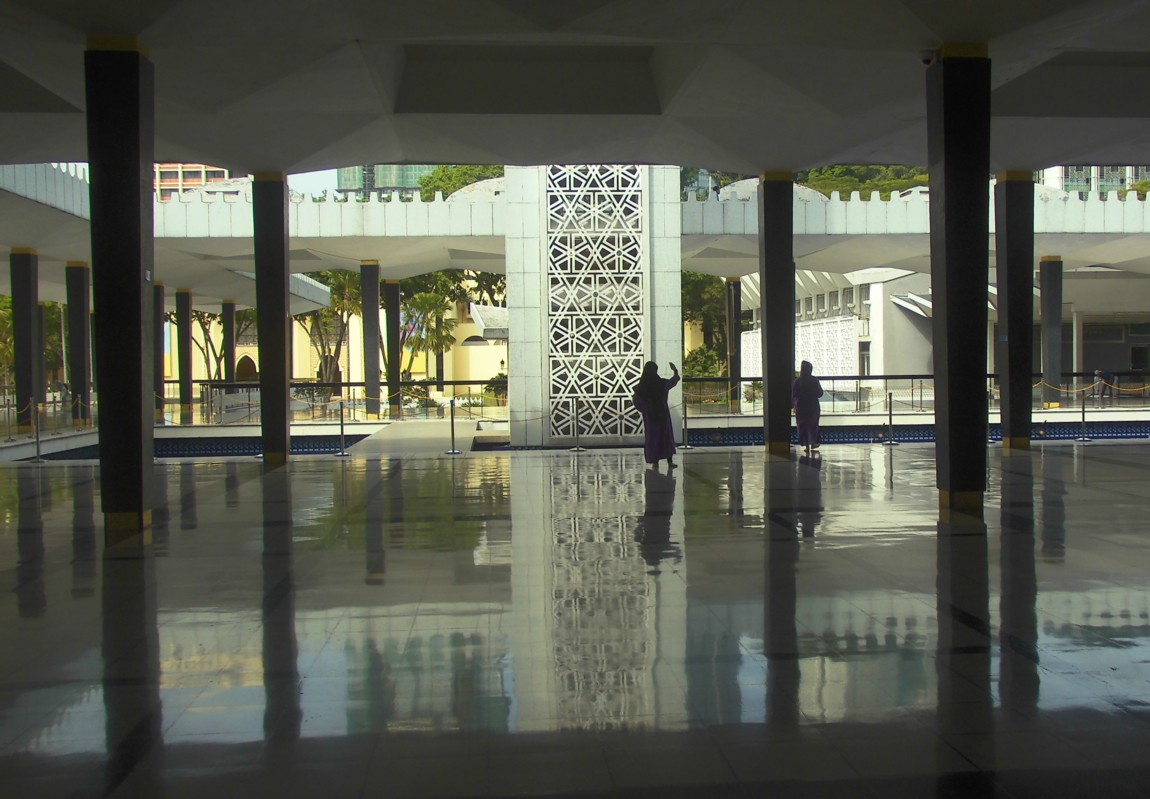
Malaysia's National Mosque in Kuala Lumpur is something they're rightly very proud of. It's a beautiful building. It's cool, and it's very welcoming. Tourist me was invited in and greeted by a volunteer guide, who told me all about the place, the prayer schedule, and the special situation during Ramadan, which was in full swing at the time.

I've been invited into lots of mosques in Malaysia, and Indonesia too, and it's always like this. Friendly places, full of wonderful people. 


Right next door was a rather fine specialist museum, the Museum of Islamic Art. They exhibit all kinds of wonderful stuff, but perhaps the most eye-catching room was the one which housed scale models of many of the world's best known mosques (and other notable buildings of the Islamic world - the Taj Mahal for example).

There are lots of highly decorative copies of the Koran, of course.


And many and varied, beautifully arranged, bits and pieces.


I noticed an exhibition of excellent photography - the finalists in a recent competition involving Islamic subjects. As well as the fine works on show, my attention was taken by an informative exhibit which neatly encapsulated most of the composition lessons I tried to teach in the beginners' 'Taking Better Pictures' course I used to teach.

Thursday, 3 October 2013

Pool of Photography

About 20 years ago I happened on a very scenic little pool at the bottom of a small waterfall on a creek in Tasmania. I had just done a 'Taking Better Pictures' sort of photography course, and recognised the potential in the colours, shapes, and textures. I liked the resulting picture, and more importantly, the lady who ran the photo printing booth in the local K-Mart was over the moon about it.


In those days you viewed photos on pieces of paper, called prints. Your camera used rolls of film, and you had to take said rolls to K-Mart or elsewhere to get the pictures developed and printed. The people there made more money if they could persuade  people to get enlargements made, and my lady used examples of customers' work, enlarged to various degress, stuck on the wall behind her, to illustrate what you could get and what it would cost. I was flattered and delighted when she asked whether my shot could be her new demonstration image. It was there for several years. 

The other day, walking in the Budawangs,  I came across another Pool of Photography, one to rival that earlier Tasmanian one. So I got to work again. Here are the results.