Showing posts with label Canberra. Show all posts

Friday, 2 November 2018

Canberra's jugglers and acrobats, and their fine old house

If you're a political junkie you need to visit Canberra now and again. That's where the action supposedly is. Or at least, that's where most of the political juggling and acrobatics happens.

I did New Parliament House last year, so this time it was Old Parliament House's turn. For over half a century they juggled to their heart's content there. Even made a few important decisions.

You can learn all about it as you wander around the place. It's part democracy museum, and part warm and cosy, fine and comfortable old building. There were very few other visitors when I was there. I paid my $2, and I was free to roam the corridors, the two chambers, the Prime Minister's and Speaker's offices and suites, whatever I liked. There's a nice cafe and an upmarket restaurant too, or you can hire bits of it for special events even.


Downstairs there's a nice little display of some of the year's best political cartoons, entitled 'Jugglers and Acrobats'.


Malcolm didn't show quite enough skill, it turned out!

Thursday, 1 November 2018

Picture perfect

On my way down to Tassie the other day I called in on Canberra to break my journey. A lot of people claim not to like Canberra, but I think it's an excellent stopover place. There are lots of interesting institutions to inspect, as well as scenic sights and all that splendid bushland around the place.

The National Portrait Gallery has been open in its current modern building for ten years, and I hadn't previously managed to get to it. It's well worth the effort. Hundreds of old friends and acquaintances. Or that's how it feels. So many so familiar faces.

Like recently deceased singer Gurrumul, stylish ex-Governor General Quentin Bryce, and Bob Brown with his Franklin River flowing free.


A self-portrait of Ken Done.


And actors and actresses and sporting heroes galore.

Thursday, 21 December 2017

Tidbinbilla's hard rock cafe


It was lunchtime and we were visiting the Tidbinbilla Deep Space Communication Complex near Canberra. It's run by the CSIRO for NASA, and its job is to communicate with NASA's various space probes around the solar system.

It was particularly busy in the late 60s and early 70s, when Americans were commuting to and from the moon, bringing back moon rock specimens like the one in the display case. Also on display are some leftover astronaut food packages from the time, and don't they look disgusting!

Which brings me back to lunchtime. The cafe is called the Moon Rock Cafe, and some of their offerings were only marginally more appetising. We played safe, and had OK wraps and a salad, but the people on the next table left their sausage rolls almost untouched.


Overall it was a very enjoyable and informative visit. The visitor centre has space suits to try out, and shrunken versions of space rockets and moon capsules galore. Maybe it's relativity or something that causes them to come back so much smaller. Fabulous educational exhibits too on the many astronomical breakthroughs that have come out of space based observations.


And below is Voyager 2 broadcasting its pictures back to us from Uranus in 1986.

Saturday, 16 December 2017

Losing ourselves in Canberra

Everyone gets lost in Canberra. It's the wild, free-form layout of the suburban road system, and the unexpected roundabouts and hexagonal 'circuits' of the inner city. There are also lots of invisible suburbs spread out all over the countryside.

Our well-meaning sat nav lady, Karen, wasn't always much help either. But that's nothing new.

Canberra really excelled itself this trip though. We were looking for the road up to the Mount Pleasant Lookout. Karen pretty well refused to acknowledge that there was such a place, but we knew it was near the military academy, so headed towards there.

There was a promising brown road sign pointing to the right, and in through the gates of the Duntroon/ADFA complex. (I'm still working out the difference between the two institutions, but that's another story.)

In we drove, checking at the gate that it really was OK for civilians to be here, and there wouldn't be an armed response to our presence. We then spent what seemed like half an hour driving round and round these tortuous campuses. We looked for further signs (there were none), we asked directions from several friendly and helpful young military types. We saw lots of new graduates and their proud parents assembling for their graduation ceremonies. Round and round we went, until we suddenly came good. The view from the lookout (top picture) had been recommended in a tourist guide for its Lake Burley Griffin perspective. The lower picture is the view from Mount Ainslie, which we had reprised earlier in the day.

Last year we had a similar 'lost in Canberra' experience in the ANU campus. Again no clues, no signs, no way out it seemed for a while. I think it's a giant conspiracy. They think the lack of signage will buy them time when foreign invaders come to take over the Government.

Canberra's cooling pools and whirling hoons

When Canberrans venture out from their comfortable and cultured urban paradise, there are plenty of things to do. Swimming in delightful Murrumbidgee River waterholes, for instance, like Kambah Pool here.


And a good number of them seem to entertain themselves by hooning around the countryside, doing wheelies and donuts. Canberra is after all our national (hoon) capital, and the home of the Summernats Festival, described by  visitcanberra.com.au as the biggest Horsepower party in the Southern Hemisphere.


Tuesday, 4 April 2017

Cudda been Sydney, cudda been Canberra!

We spent the weekend exploring the Port Stephens area, up the coast north of Newcastle.

Captain Cook noted the fine sheltered harbour in 1770, as he sailed up the coast after leaving his recommended settlement site, Botany Bay, which later turned out to be a dud. On the way up he'd also noted Port Jackson (Sydney Harbour), which turned out to be the 'best harbour in the world' and which became the actual 1788 settlement. But if he hadn't, then Port Stephens might have become Sydney instead. The harbour is the same size, and geographically as complicated. It's not as deep though.

We enjoyed our visit to the volunteer-staffed marine rescue centre, near the mouth of the harbour.


In the 20th century, when the newly federated Australia was looking for a site for its permanent capital, Port Stephens was one of the contenders. Walter Burley Griffin even drew up plans for a capital city, looking rather Canberra-like of course. It never got built, and one reason I heard for it not being chosen was that it could have been too easy to invade from the sea. (It's also not somewhere between arch rivals Sydney and Melbourne.)

Here's a link to a Newcastle Herald piece showing 'Pindimar City', which could have been the 'New York of Australia', overlaid on Google Maps: http://www.theherald.com.au/story/1412468/topics-pindimar-city-now-figment-of-google/

Below: the marina at Nelson Bay


Saturday, 8 October 2016

A world's top 100 objects and a very Boolean museum


Top 100 at least in terms of giving us a quick history of civilisation, and at least as judged by the British Museum and brought to us courtesy of the Australian National Museum in Canberra.

This is Augustus Caesar, the first Roman emperor to be called an emperor. Other top 100 artifacts include the sarcophagus of the ancient Egyptian Shepenmehyt, the Lewis Island Chessmen, an Arnhem Land basket, an Inca gold llama, a Samurai sword, and a Sharia Law compliant credit card. Plus some very colourful New Guinea tribal shields with modern beer label designs.

I quite like the Australian National Museum, especially that giant 'Garden of Australian Dreams' multi-themed map thing that you can walk around, with linguistic boundaries and lots more marked on it. 


I don't go much on the big loopy roller coaster 'Boolean string' thing at the entrance. ‘We have subtracted (by Boolean operation) a volume of tangled space in the form of a ribbon or knot from a solid sphere-like object. The loop is a small piece of this string, which entangles and defines the entire building – a metaphor for the strands that tie us together as a nation.' As explained by the museum's website.

The museum's in an attractive location on a peninsula that protrudes into Lake Burley Griffin.


Thursday, 6 October 2016

Australian National Botanic Gardens


We had a quick look at Canberra's botanic gardens, and it was enough to see that we'd need to come back and spend a day there another time to take it in properly. It's a big and complex site, and boasts 6300 species of native plants. They say it's the only place in the world where you'll see this diversity of Australian flora in one place.

The layout was rather confusing, mind.  We tried to follow the 'main loop' track, but kept finding we'd wandered off it and were heading in the opposite direction to what we'd expected from the map. But not to worry, it was all very pleasant.


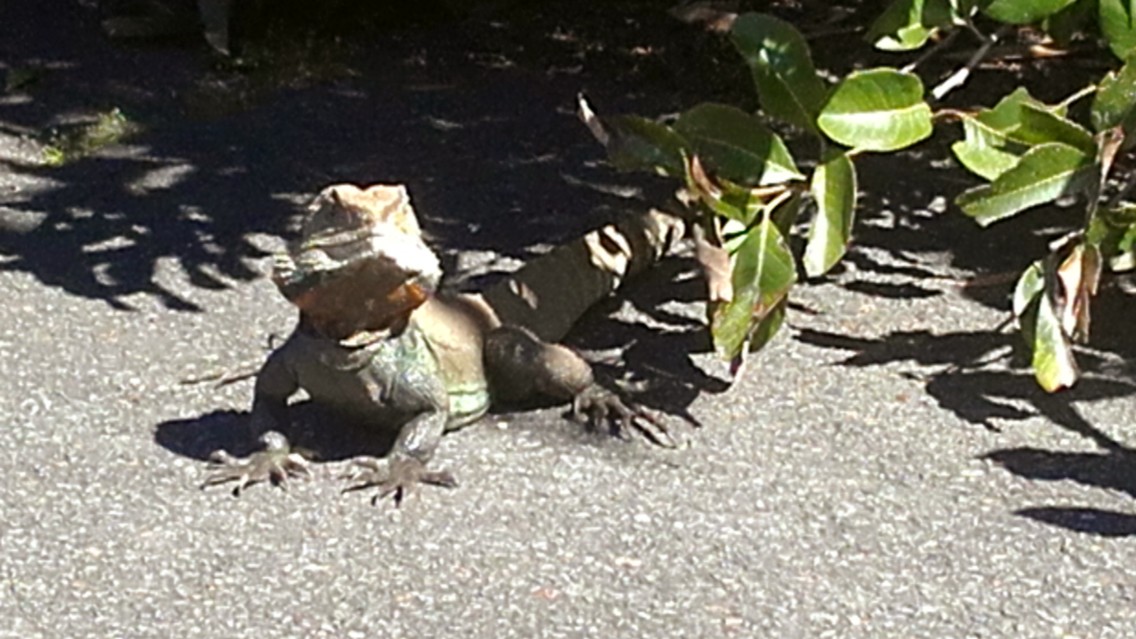
And the (reptilian) natives were quite unfazed by our presence.


Tuesday, 4 October 2016

Black Mountain blackout


Canberra's Black Mountain, with its telecommunications tower, is the obvious place to go for a panoramic view of the city. It's all spread out before you. And there's lots to see - lake, suburbs, museums, parks, parliaments, roads and bike paths.


When we arrived and tried to lock the car, the remote keyless car lock wouldn't work. This was a bit of a mystery for a while, till I remembered hearing something about this once before. It's the powerful electromagnetic field from the transmitter that does it, and we were relieved to find it all worked properly again later, once we'd driven off down the hill.

Wonder what it does to you if you work all day there?


Saturday, 1 October 2016

Parliament House

You'd think a political junkie like me would have made it to Parliament House before now. It's only been there for about 30 years, after all. Anyway, I finally made it the other day, and can report that it's quite an impressive building.

I remember clearly when it was being built in the 1980s. There was huge controversy about the billion dollar price tag. At about the same time, they were also building those six dreaded submarines that hardly ever work, and each one of those was going to cost almost as much as Parliament House. (By the way, we've been told recently we have to have a whole new set of submarines, and this time there's to be 12 of them and they're to cost $30 billion, no $50 billion, maybe $100 billion. Who cares, it's only money. And by the way, what are they for, actually? No one's bothered to tell us.)


Back to Parliament House. You get to check out the Senate and the House of Representatives, you pose with your favourite Prime Minister (or Governor General). You inspect Australia's very own copy of England's Magna Carta (read the explanation of its significance - it's nicely written and rather inspiring). And you can stroll on the lawn on the roof.

It was a non-sitting day when we were there. I've a feeling I'll be along again soon, on a sitting day maybe.

Doubt whether I'll find out what the submarines are for though.

* (Actually, Paul Keating was probably the best Prime Minister of them all. Gough certainly had his merits though.)


Thursday, 29 September 2016

Our very own Floriade festival


We headed down to Canberra the other day to re-acquaint ourselves with the charms of the national capital.


It's Floriade time, Canberra's big spring flower festival, and all the oldies and school holiday family vacationers are into the Floriade pilgrimage.


We'd planned to see what it was all about, but in the end, decided to prioritise some of the other places we'd had in mind. We only had two half days to explore the city, so Floriade would have to wait another year.


But what's this? A great little display of tulips in Moss Vale in the Central Highlands. Surely this will do us instead!