Showing posts with label indigenous. Show all posts

Friday, 13 November 2020

Bound for South Australia - 6: Wilpena Pound & St Mary Peak

It's one of the classic walks: the St Mary Peak circuit at Wilpena Pound in the Flinders Ranges. I had an attempt at it over 40 years ago, but we ran out of time and/or inclination when the track became a bit steep and precipitous in the approach to the Peak.

No false moves this time though. Here are my walking companions as we set out from the Wilpena resort, ready for our 9 hour, 21km day walk.

The pound itself is a large saucer-shaped area, several kilometres across, with a surrounding rim of mountains. Origin stories include giant serpents and meteorite strike. I think the mainstream one involves geological deformations and differential erosion rates.

In the 19th century it was used briefly as a grazing property, initially supporting many thousands of sheep and cattle. A few years later they were almost all dead, following the inevitable drought.


Approaching St Mary Peak


Exploring the top


Looking to the north, and to some of those serpentine mountain chains winding through the Flinders Ranges landscape


Back at the Wilpena resort, every evening there's a bit of a welcome talk and story telling session from a local traditional owner.


Tuesday, 10 November 2020

Bound for South Australia - 3: Wilcannia

I had a lunch stop in Wilcannia. It's on the Barrier Highway between Cobar and Broken Hill, and it's often mentioned in the context of poverty, disadvantage, and social problems.

From Wikipedia:  From the 2016 Census, Wilcannia had a population of 549 with 407 (74.4%) people being of Aboriginal or Torres Strait Islander descent, mostly from the Barkindji nation.[11] Wilcannia has 223 private dwellings.[1] The town was listed as one of the most socially disadvantaged areas of New South Wales according to the 2015 Dropping Off The Edge report.[12]


It's on the Darling River, and used to be a major inland port. These days there's often no water, because of climate change induced droughts, and massive theft by upstream irrigators. Some did arrive earlier this year though, and the river isn't quite dry at the moment.


Sunday, 27 January 2019

Barangaroo: a tale of two Australia Days

The prize exhibit at Barangaroo this Australia Day was the very fine 'Always' sculpture (as in "Always was, always will be: Aboriginal land") So that was my primary focus yesterday morning.

If I'd been earlier out of bed, I'd have got to see the early morning smoking ceremony, and maybe the other indigenous entertainments that had been promised. The smoking ceremony chap was still in action though, and was in much demand for photographs still. His fellow participants and entertainers seemed to have taken an early mark?

My take on what the sculpture's about: I approached from the shiny side, and saw the back-to-front version, and the shiny illusory reflections of myself and the modern city. Then from the other side it's the way it should be: very solid, a little rusty, but timeless and sustainable, the real deal.


Meanwhile on the harbour just behind me, the usual red-white-blue Australia Day waterborne festivities were going on. A huge flotilla assembled to watch the end of the traditional ferry race under the Harbour Bridge, and it was all quite exciting!


Here's the end of the race, with the Port Authority's firefighting boat clearing a path through the crowd.


The first, second, and third ferries, I think. (I couldn't find any sort of official race result report when I did a search just then. Only ads for passengers - let's keep our money-making priorities after all!)

In fact there's a lot of middle ground going on between the two Australia Days, despite the deliberately incendiary pronouncements of partisan activists like the current (very temporary) Prime Minister, and despite the media emphasis on conflict and division. I've a feeling we'll work out an appropriate solution to our big National Day conundrum before too long.


Saturday, 27 January 2018

Invasion Day: 'Worst date ever'

The best date ever to highlight the worst date to have as Australia's national day is of course 26 January, Australia's official national day.

It marks the day in 1788 that Captain Phillip and his First Fleet sailed into Sydney Harbour to start the British penal colony. They'd arrived at their intended destination, Botany Bay, a few days earlier, but found it to be without drinking water, so relocated.


To the indigenous population 26 January thus marks the start of the invasion and colonisation of their lands.

Over the years it's become the thing to mark the day with rallies and marches, and other symbolic events to draw attention to their continuing plight. It's got to the stage where the Invasion Day events in Australia's capital cities are almost overshadowing the mainstream celebratory events. A major theme this year has been the 'Change the Date' movement, highlighting all the other dates when Australians could all come together and celebrate their nation without offending a rather essential core group of them. Needless to say, the major political parties have yet to come to grips with this, and for now are happy to be on the losing side of history.


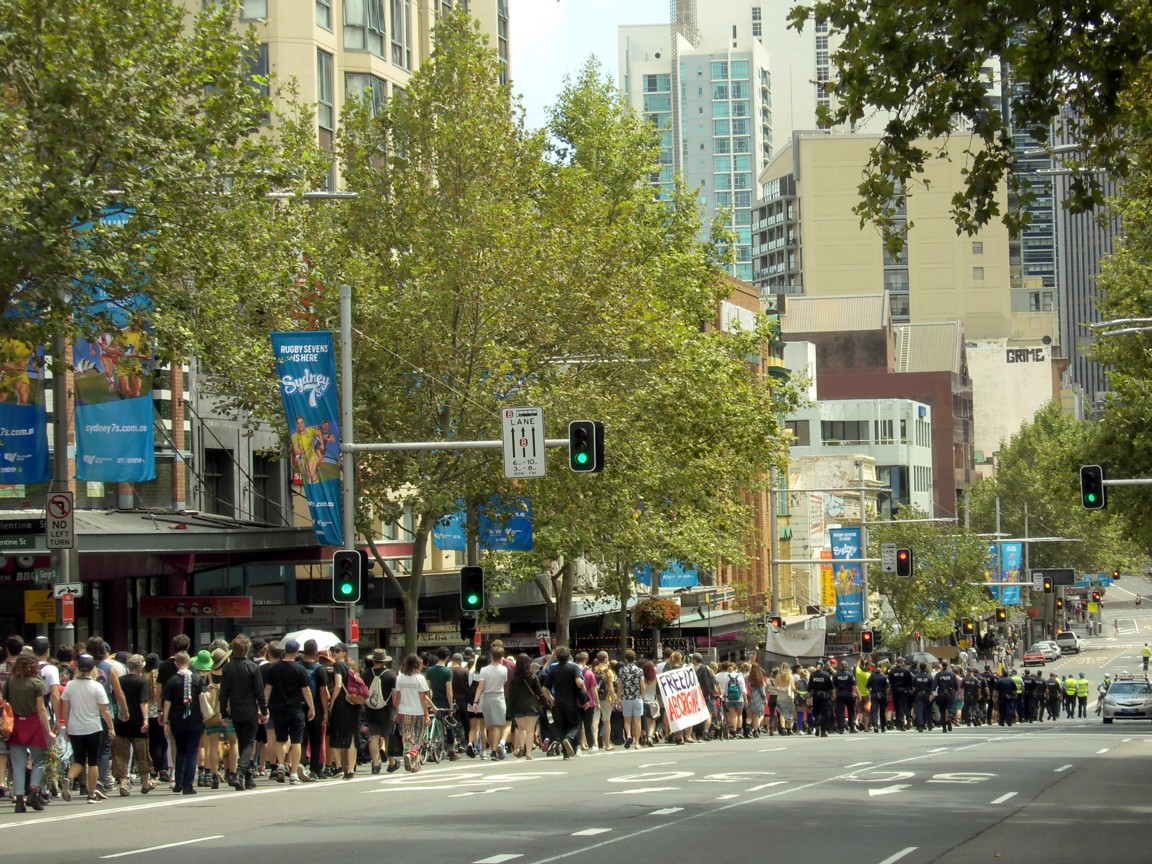
I attended the Sydney event, which started with a rally at 'The Block' at Redfern, and then became a march through city streets to Camperdown. It was a big deal.


As one of the speakers noted, there wasn't a conventional Australian flag to be seen in this crowd. I noticed too that when I strolled back through the city through the usual Australia Day crowds doing their more usual Australia Day strollings, a large proportion of them were carrying Aboriginal flags as well as the conventional ones.


Tuesday, 26 January 2016

Invasion Day


"Always was, always will be......... Aboriginal land". The continuous chant was loud, the numbers were large, and it made an interesting and meritorious alternative to the usual Australia Day attractions. The Invasion Day march went from the Block in Redfern into the city.

  
There were an awful lot of police officers on duty for it, a lot of them with video cameras. As far as I'm aware there weren't any untoward incidents requiring any subsequent use of the footage.


From the pointy political end of the issue, on to the softer sell. I walked back to Victoria Park in Camperdown, where the annual Yabun Festival of aboriginal culture was being held. 'Yabun', by the way, means 'music to a beat', and there was lots of music, plus traditional dancing demonstrations, and information and other stalls selling T shirts with the message below.

The Australia Day vs Invasion Day dichotomy comes up every year. And so it should. At least until they move Australia Day to the first of January, to commemorate the founding of Australia in 1901, rather than the day in 1788 that the British officers of the First Fleet erected a flagpole at Sydney Cove and declared New South Wales as a British colony. (This was almost a week after they arrived in Botany Bay, by the way.)

It's good anyway to see that the mainstream Australia Day organisers are incorporating indigenous performers and ceremonies into the proceedings too. Here's Jessica Mauboy singing the national anthem in the Gadigal (Sydney) language on top of the Harbour Bridge. Click here:
https://www.youtube.com/watch?v=g61BocUcss0


Tuesday, 10 February 2015

Adivasi

This lady is a Keralan 'adivasi', a member of an  indigenous 'tribal' group, in the Wayanad region, who I was introduced to. It's often been said that some indigenous Indians look effectively identical to some Australian aborigines, and I think this is a good illustration.

I gather there's still lots of discussion, and lots of research being done on the links between the two populations, but I've been reading that there's a view that about 4000 years ago there was a migration wave from southern India to Northern Australia, and this brought about similarities in DNA and in languages, and brought the dingo to Australia.

Here's an interesting piece on this:
http://www.pnas.org/content/110/5/1803.abstract

Tuesday, 3 December 2013

Surviving the museum


 'Surviving Australia' is the name of one of the galleries at Sydney's Australian Museum. It's packed with scary venomous spiders and snakes, things like sharks and crocodiles that eat you, stingers, biters and buzzy things, all the things the tourists love. And so do we!

It's been 20 years or so since I'd last explored the place, and it's come on quite nicely. There's still the classic galleries with the the fine collections of stuffed birds, insects, marsupials etc. There are skeletons galore, and of course dinosaurs. Menacing, noisy dinosaurs. Australian ones too these days. There are rocks, gemstones and meteorites.

A lot of work has gone into making things very accessible and exciting for kids and for tourists.  
There's also a classy gallery on indigenous Australia, and intelligent displays on environmental degradation and extinctions.

I think an Australian Museum visit is a must for visitors with a few hours to spare and a wish to gain a good quick introduction to the country, and it should probably be on the agenda for all of us locals too now and again.