Showing posts with label aboriginal. Show all posts

Friday, 29 November 2019

Taroko's aboriginal-run hotel

Until the late 17th century, Taiwan was predominantly inhabited by its aboriginal population, though there had been strong Spanish, Portugese, and Dutch presences, along with many others. It's a particularly complicated history.

But then along came the Ming Dynasty Han Chinese, and they came to dominate the place, with the aborigines retreating to the mountains. It's a bit analogous with Australia and its European invasion a bit later. And the Japanese ran the place from 1895 until 1945, of course.

 But back to the aborigines. They're in a bad way generally, but the Government runs generous programmes to support them, we were told.

There's also an interesting private programme, in the shape of the Taroko Village Hotel. It's owned by a wealthy non-aboriginal Taiwanese, but the employees are aboriginal, and the hotel is styled on the original village.


They serve traditional foods, notably different from the usual Chinese fare.


It's rather expensive too. We only dined there. Guide Samantha said their last group also stayed there. I asked her what went wrong. "Nothing went wrong", she said. I think it was just our budget that went wrong!

Sunday, 27 January 2019

Barangaroo: a tale of two Australia Days

The prize exhibit at Barangaroo this Australia Day was the very fine 'Always' sculpture (as in "Always was, always will be: Aboriginal land") So that was my primary focus yesterday morning.

If I'd been earlier out of bed, I'd have got to see the early morning smoking ceremony, and maybe the other indigenous entertainments that had been promised. The smoking ceremony chap was still in action though, and was in much demand for photographs still. His fellow participants and entertainers seemed to have taken an early mark?

My take on what the sculpture's about: I approached from the shiny side, and saw the back-to-front version, and the shiny illusory reflections of myself and the modern city. Then from the other side it's the way it should be: very solid, a little rusty, but timeless and sustainable, the real deal.


Meanwhile on the harbour just behind me, the usual red-white-blue Australia Day waterborne festivities were going on. A huge flotilla assembled to watch the end of the traditional ferry race under the Harbour Bridge, and it was all quite exciting!


Here's the end of the race, with the Port Authority's firefighting boat clearing a path through the crowd.


The first, second, and third ferries, I think. (I couldn't find any sort of official race result report when I did a search just then. Only ads for passengers - let's keep our money-making priorities after all!)

In fact there's a lot of middle ground going on between the two Australia Days, despite the deliberately incendiary pronouncements of partisan activists like the current (very temporary) Prime Minister, and despite the media emphasis on conflict and division. I've a feeling we'll work out an appropriate solution to our big National Day conundrum before too long.


Saturday, 28 April 2018

The Corn Trail

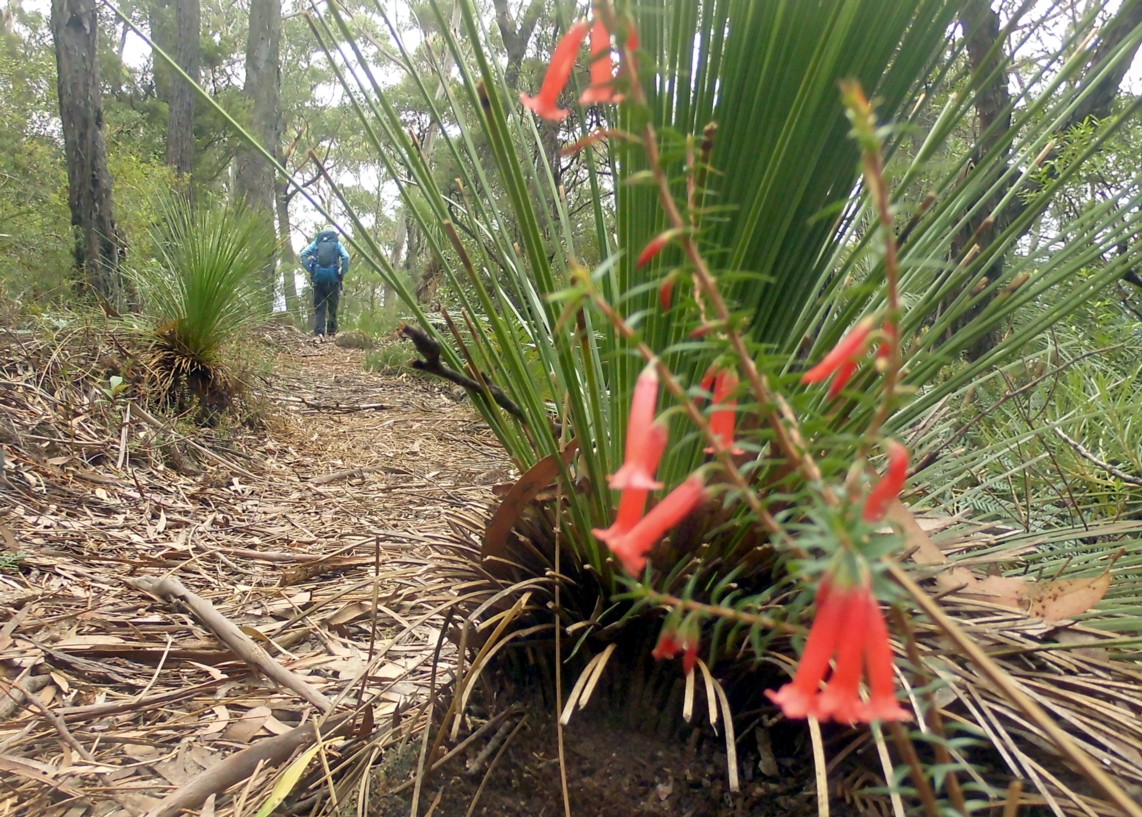
The Corn Trail is a recently renovated historic-interest bushwalk in the Monga National Park, inland from Batemans Bay. I'd actually never heard of it (or of Monga National Park), but some of my bushwalking companions had, and were keen to check it out. It's 12 to 15 km long, depending on which authority and/or GPS device you trust, and involves an ascent or descent of about 650m.

From the National Parks website:

Take a journey back in time and follow a route that has been used for thousands of years. Popular today with bushwalkers and horse riding groups, Corn Trail walking track was originally used by Aboriginals on their seasonal travels between the coast and the tablelands, then later by European settlers on pack horses carrying supplies.

This historic trail takes you downhill from high mountain ridges to deep rainforest-filled valleys. You'll pass the gently flowing Buckenbowra River, wander through warm temperate rainforest and walk through eucalypt forests. You’ll also catch glimpses of Mount Budawang and the sandstone peaks of Pigeon House and Castle Mountain further north.

It’s a difficult walk, so you’ll need to come prepared, but the scenery is worth it. A carpark at the bottom allows you to do a car shuffle and have a vehicle and supplies waiting for you at the end.

It's not that super-difficult, especially if you do it from north to south (ie downhill). But it was more substantial than we'd expected, and we even met a couple of people with a full backpack, doing the uphill direction to practice for a big Himalayan excursion to come. They told us there was a nice surprise to come.

The surprise was a beautiful patch of rainforest, a total contrast to the earlier vegetation types we'd passed through.

Saturday, 27 January 2018

Invasion Day: 'Worst date ever'

The best date ever to highlight the worst date to have as Australia's national day is of course 26 January, Australia's official national day.

It marks the day in 1788 that Captain Phillip and his First Fleet sailed into Sydney Harbour to start the British penal colony. They'd arrived at their intended destination, Botany Bay, a few days earlier, but found it to be without drinking water, so relocated.


To the indigenous population 26 January thus marks the start of the invasion and colonisation of their lands.

Over the years it's become the thing to mark the day with rallies and marches, and other symbolic events to draw attention to their continuing plight. It's got to the stage where the Invasion Day events in Australia's capital cities are almost overshadowing the mainstream celebratory events. A major theme this year has been the 'Change the Date' movement, highlighting all the other dates when Australians could all come together and celebrate their nation without offending a rather essential core group of them. Needless to say, the major political parties have yet to come to grips with this, and for now are happy to be on the losing side of history.


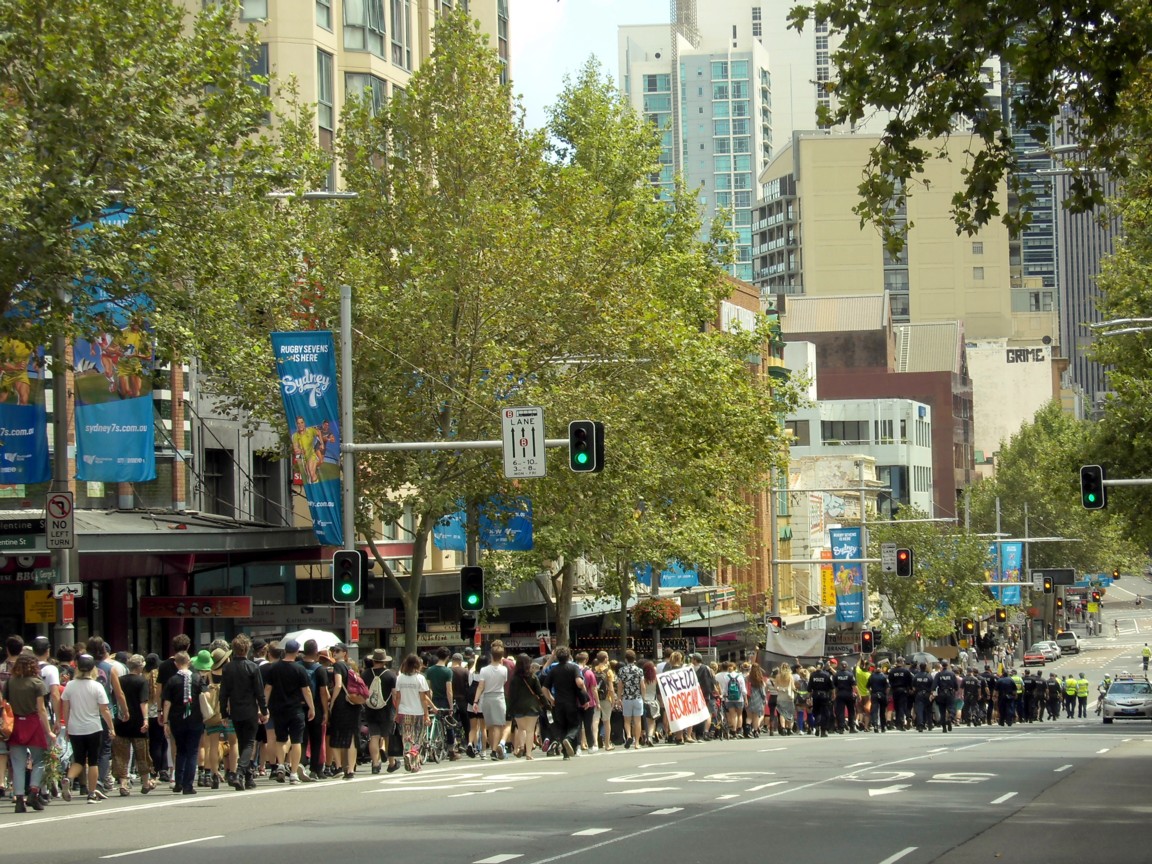
I attended the Sydney event, which started with a rally at 'The Block' at Redfern, and then became a march through city streets to Camperdown. It was a big deal.


As one of the speakers noted, there wasn't a conventional Australian flag to be seen in this crowd. I noticed too that when I strolled back through the city through the usual Australia Day crowds doing their more usual Australia Day strollings, a large proportion of them were carrying Aboriginal flags as well as the conventional ones.


Friday, 3 June 2016

Sea of hands


Looking across from Balmain the other morning, I could see an Aboriginal and a Torres Strait Islander flag spread out on the grass of Barangaroo Park.

It was ANTaR's  'Sea of Hands', sprung up once again to mark Reconciliation Week. I made my donation and planted a hand.


ANTaR, by the way, stands for Australians for Native Title and Reconciliation. You can read about the fine work they're doing on their website:  https://antar.org.au/


Thursday, 17 March 2016

Museum of Sydney


I've long had a soft spot for  the Museum of Sydney, although it's very small, and doesn't have a great deal of stuff in it.


It's a pleasant space though, and does a good job of telling you a bit about the history of the city in the hour or so that you devote to it.


There's usually a special exhibition on, like the Lloyd Rees black & white drawings of early twentieth century Sydney that I encountered today.


The Museum of Sydney is at the junction of Phillip and Bridge Streets, on the site of the first Government House, a model of which is perched above some of the relics unearthed from the site.


One new (to me) permanent addition is the room devoted to the local aboriginal clans, and the unfortunate history of their early interactions with the British settlers.


I've always been most taken though, with the scale models of the First Fleet ships - usually all 11 of them, though one seemed to have gone missing today. Until I first set eyes on this, I'd somehow had much less of an idea of what Governor Phillip's amazing expedition half way across the world had been all about. And remember, they all had to stay within sight of each other!


Tuesday, 26 January 2016

Invasion Day


"Always was, always will be......... Aboriginal land". The continuous chant was loud, the numbers were large, and it made an interesting and meritorious alternative to the usual Australia Day attractions. The Invasion Day march went from the Block in Redfern into the city.

  
There were an awful lot of police officers on duty for it, a lot of them with video cameras. As far as I'm aware there weren't any untoward incidents requiring any subsequent use of the footage.


From the pointy political end of the issue, on to the softer sell. I walked back to Victoria Park in Camperdown, where the annual Yabun Festival of aboriginal culture was being held. 'Yabun', by the way, means 'music to a beat', and there was lots of music, plus traditional dancing demonstrations, and information and other stalls selling T shirts with the message below.

The Australia Day vs Invasion Day dichotomy comes up every year. And so it should. At least until they move Australia Day to the first of January, to commemorate the founding of Australia in 1901, rather than the day in 1788 that the British officers of the First Fleet erected a flagpole at Sydney Cove and declared New South Wales as a British colony. (This was almost a week after they arrived in Botany Bay, by the way.)

It's good anyway to see that the mainstream Australia Day organisers are incorporating indigenous performers and ceremonies into the proceedings too. Here's Jessica Mauboy singing the national anthem in the Gadigal (Sydney) language on top of the Harbour Bridge. Click here:
https://www.youtube.com/watch?v=g61BocUcss0


Tuesday, 10 February 2015

Adivasi

This lady is a Keralan 'adivasi', a member of an  indigenous 'tribal' group, in the Wayanad region, who I was introduced to. It's often been said that some indigenous Indians look effectively identical to some Australian aborigines, and I think this is a good illustration.

I gather there's still lots of discussion, and lots of research being done on the links between the two populations, but I've been reading that there's a view that about 4000 years ago there was a migration wave from southern India to Northern Australia, and this brought about similarities in DNA and in languages, and brought the dingo to Australia.

Here's an interesting piece on this:
http://www.pnas.org/content/110/5/1803.abstract