Showing posts with label Sydney University. Show all posts

Wednesday, 4 March 2020

'Combatting viral panic, misinformation, and racism' - they're not listening in the supermarket!


The other night I attended an excellent public meeting at Sydney University. It was about the whole Covid-19 coronavirus thing. There was a public health expert, other academics, politicians, the vice chancellor, and an ex-racial discrimination commissioner. The Chinese community have been having a hard time of it recently, due mainly to the good works of public health workers in Wuhan, China, who first identified the epidemic. (I have a theory that it may have been around elsewhere for some time before the Wuhan people did their bit - they were just more on-the-ball than their counterparts in other countries.)

The theme was 'Combatting viral panic, misinformation, and racism'.

Next day I called in to the Westleigh Aldi, and the panic was fabulously on show! All the toilet paper and facial tissues had gone. And most of the rice and pasta too!

The car park was fuller than I'd seen it before, and shoppers were discussing how they'd done the rounds of the Coles and Woolies stores before coming to this generally quiet one.


Fortunately we'd had an inking of this the day before, when we'd heard the radio discussion about why you didn't need to panic-buy. So we'd panic-bought!


Friday, 23 March 2018

Waves, explosions, and a rock-star physicist

The other night I met Tara Murphy. She's an Associate Professor of physics at Sydney University, and she's an astrophysicist who knows all about neutron stars, gravitational waves, radio astronomy, and how to give a riveting public lecture. She was also the winner of the Young Tall Poppy of the Year award in 2012 after all!

She was describing the spectacular events of August last year, when she and her team were among the first in the world to observe radio and gravitational waves coming from the same event.

Two neutron stars were circling each other 130 million years ago, spiralling in faster and faster until they collided with an incredible output of energy. After all this time the radio waves arrived here about a second after the gravitational ones, for reasons I've forgotten. Here's the sound (sort of) of the event: https://www.youtube.com/watch?v=Tu8dcMoTl4U 

She tells the story far better than I can, so take a look at this Sydney Uni piece on her work. An explanatory comic-strip mural which was created is included, and may assist: Gravitational waves breakthrough


Thursday, 30 March 2017

It's all talk


And that's fine! There are so many public talks, discussions, debates, slide shows, and lectures you can go to around Sydney. They're mostly free and usually they are interesting and informative.

I sometimes go to the lunchtime talks in the Mitchell Theatre of the Sydney Mechanics School of Arts, at 280 Pitt St. It's a welcoming and relaxing environment, and you don't even need to reserve a seat for these. Just rock up. Here's their programme: https://smsa.org.au/events/

The other day it was a presentation of 'Sydney in the 60s' photography by a former professional Government photographer.

The various universities all have extensive programmes of intellectual stimulation too - often tailored for interested lay folks like me. As part of Sydney University's 'Sydney Ideas' series, for example, there will be a talk on gravitational waves next month, which I plan to get along to. I can't speak too highly of this series. I've been exposed to some of the world's finest visiting brains expounding on science, technology, politics, philosophy, history, futurology. You name it, it comes to Sydney. Here's a link to Sydney Uni events: http://whatson.sydney.edu.au/events  And UTS, WSU, and UNSW all run similar things.

Lots of other organisations do excellent stuff too. One I'd mention is STEP (the South Turramurra Environment Protection group, it stands for).  Not only have they successfully brought about the protection of many bits of precious bushland, but they've produced a variety of books and the definitive high quality bushwalking maps of the northern Sydney region. They also put on regular public talks of a very high standard. No reservations required. Last week I went to a presentation on paleoclimatology. It's a pity there were no climate change sceptics there. The million-year timescale graphs displayed of temperature, carbon dioxide, and sea level, with the seven or eight ice ages followed by a vastly steeper and more sudden effect from industrialisation, make any talk about "climate change has always happened and is completely natural" look ludicrous. Here's a link to STEP: http://www.step.org.au/index.php


There's an umbrella website that collects most of these events together, to make life easy for talkaholics like me. It's called 'Sydney Talks'. Check it out:
https://www.sydneytalks.com.au/

Monday, 21 July 2014

Lesser known museums No.138: Nicholson Museum

Just along the road and across the main quadrangle from the Macleay Museum, is Sydney University's other little gem museum - the Nicholson.

I forgot all about it while I was at the Macleay the other week, so headed back on Friday to make amends. While the Macleay Museum is about natural history, the Nicholson is about

antiquities. Very manageably sized collections of antiquities from ancient Greece, Cyprus, Egypt, Italy, and the 'Near East' (including Mesopotamia, Pakistan and India).

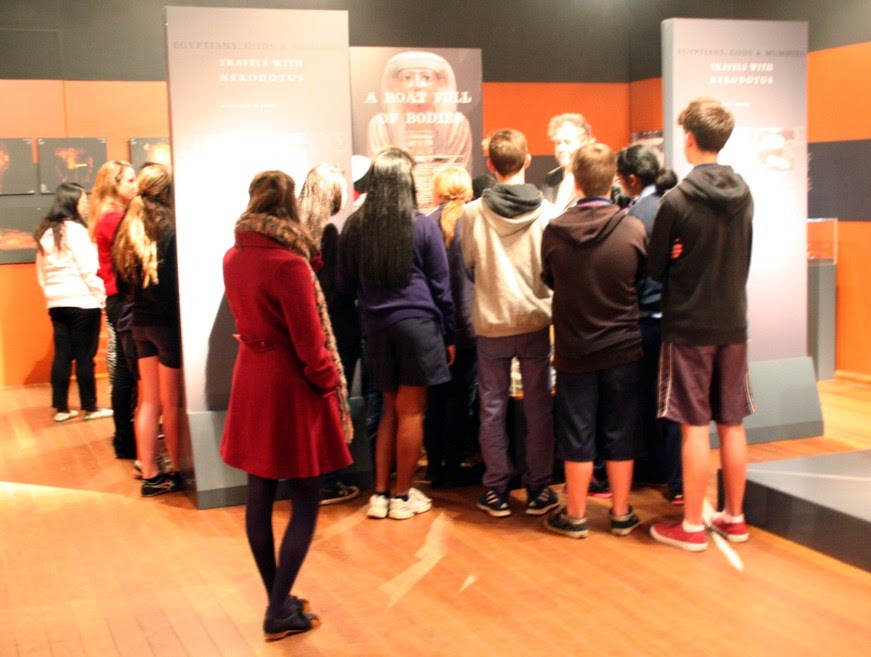
I liked the Egyptian mummies of course. They've got three human ones, and X rays or CT scans or something of one of them, and they've also got mummified cats, birds, and crocodiles, would you believe. The section was about Egypt as seen through the eyes of Greek travel writer Heroditus, in 450BC. As well as putting all those early pyramid reviews on TripAdvisor, he busied himself recording recipes for mummification. Feel free to try it out for yourselves, but stand well to the side when you pull out the plug. Hopefully the kids in the school group (or ancient history & mummification tutorial group?) will take all necessary precautions.


A well promoted attraction in the Greek section was the Lego Acropolis. That seemed to have been removed or dismantled when I got there though. Never mind, the 1895 plaster one was there, and it's not a bad Acropolis at all.

Wednesday, 9 July 2014

Lesser known museums No. 137: the Macleay Museum

Sydney's full of funny little niche museums. For example, there's the Army Artillery Museum, the Scout Museum, the Tennis Museum, Fort Denison, Hyde Park Barracks, the Justice and Police Museum, the Museum of Australian Currency Notes, the Museum of Freemasonry, the Susannah Place Museum, the Bus Museum, the Harbour Bridge Museum, the Jewish Museum, the Sydney Mint, Sydney Observatory, the Tramway Museum, and the White Rabbit Gallery, to name but a few.


Two such examples are located at Sydney University. There's the Nicholson Museum ('largest collection of antiquities in the southern hemisphere'), and there's the Macleay Museum, which I popped into last week for the first time.


This one is all about natural history, but it's also part of our history. It's got enormous collections of all sorts of things, many dating from before Australia's European settlement. Especially insects, but also mammals (including a Tasmanian Tiger skeleton), ethnography (New Guinea mainly), historic photographs, and scientific instruments (including the University's first primitive computer). Most of the collection, especially the most fragile historic things, are kept deep in the bowels of the building somewhere, but the nicely sized gallery that's open to the public has a beautifully traditional museum-like feel to it, and a sufficient collection of all this stuff to keep you enthralled for a good hour or two.


 The story of the Macleay family is quite interesting. Alexander Macleay was the Colonial Secretary in the early 19th century, and was a prolific gentleman collector who brought his enormous collection with him. Two subsequent generations of Macleays kept up the tradition, did useful work in classification, met Charles Darwin, the lot. When the collection outgrew their house (the fine Elizabeth Bay House - a heritage house and museum in its own right, which I've yet to visit), they donated it all to the university.


Friday, 4 July 2014

Sydney Uni: Graffiti & gravitas


Sydney University does a good line in graffiti. They even have a famous and well signposted graffiti tunnel, to highlight this particular academic specialty.


But it's not the whole story. Sydney Uni is indeed Australia's oldest University, and is within Australia considered a solid and prestigious institution. How well regarded is it by world standards? Well, it is, sort of. According to the Times Higher Education World University Reputation Rankings for 2014, it's right up there in the 61-70 band, down a bit from 49th last year, and sadly a bit behind Melbourne University and the Australian National University in Canberra. (Harvard University comes in at No.1 again, and I can't resist mentioning Imperial College London still being up there at No.13)

Sydney Uni does have a lovely old campus, well located and with fine buildings, old and new. It has got a beautiful feel to it, especially on perfect blue sky days like today. It's got an excellent outreach programme, with all kinds of fabulous talks and other events which the public are invited to attend. And, if you believe the local media at least, it does churn out lots of useful research results, as well as lots of doctors, engineers, lawyers etc.

Like most Australian tertiary education institutions, it's got awfully interested in recent years in the education business, as opposed perhaps to the business of educating people, and the campus is full of high fee paying overseas students. I watched a little post-graduating ceremony photo shoot, where the group got their instructions on the throwing-your-mortar-boards-into-the-air routine, watched by their proud parents, over from China.

Some things haven't changed though since my student days. Still seems to be lots of politics, lots of meetings, lots of notices and graffiti. Maybe the overseas students aren't pulling their weight in that department, but maybe, just maybe, they'll learn something from it, and their time here will have been worthwhile.