Showing posts with label Central Java. Show all posts

Thursday, 13 November 2014

A day at the beach

Swimming's banned, and people don't take off their clothes the way they do here, but they still have lots of fun.

I spent a pleasant few hours in the beach resort of Parangtritis, 27km south of Jogja, in Central Java. There's dark, volcanic sand, and there's quite a big surf. In Australia it probably wouldn't be considered a particularly dangerous beach, but in Australia most people can swim.

There are other ways of having fun at the beach though, like riding around on horse carts, being covered by cool wet sand, or lunching on excellent seafood dishes for a dollar or so.


Or you could take selfies with your extra long selfie stick.


Wednesday, 5 November 2014

Rebuilding Prambanan - a job for life?

And Prambanan does need a bit of rebuilding, as you can see in this shot of the Candi Sewu complex, a kilometre to the north of the 'main' Prambanan complex.

Candi Sewu was a Buddhist complex, as opposed to the main complex, which was Hindu. Both were built in the ninth century, and they have been abandoned, rediscovered, demolished by earthquakes (with the last big one in 2006), and rebuilt several times. Here's the link to the Wikipedia piece, for a much better description and history of it all than I could do: http://en.wikipedia.org/wiki/Prambanan


Anyway, I'm getting ahead of myself. On a previous trip to Indonesia nearly 30 years ago I made the effort to visit Borobudur, the other great temple complex in the Yogyakarta region. That's a Buddhist one, and quite an impressive edifice it is. I somehow wasn't as motivated that time to get out to Prambanan, even though it's actually very close and convenient to the city.

On this last trip I rectified that, and was rewarded with a very pleasant day out.

The main upstanding structures are beautiful things. But I was very struck by how big a job they still have in front of them. Candi Sewu consisted of a main central temple, plus 240 'guard temples' all around it. Very few of these guard temples are still standing. The rebuilding effort seems rather slow and half-hearted, and looks like it could keep the handful of construction crews busy for centuries, rather than decades.

Prambanan's about 17km north east of Jogja, right alongside the main Solo road, and I got there easily and comfortably on an air-conditioned  Jogja city bus.


Wednesday, 29 October 2014

Super markets and slow markets

As ever on my Indonesian visits, the markets provided lots of colourful imagery. Whenever appropriate I ask for permission to photograph people, and they're almost always extremely happy to oblige.


At the place where my Lonely Planet said Jogja's bird market was to be found, was this conventional old

style produce market, with photogenic scenes featuring eggs, chickens, coconuts etc, and their equally photogenic vendors. Someone told me the bird market itself had moved a couple of kilometres away. (Wonder if that was during the bird flu epidemic a few years back?)
I also came across several air conditioned western style shopping centres (complete with McDonalds), and even one such four-storey centre packed entirely with computer and mobile phone shops. Things are changing in Indonesia.

A rather big part of the Yogyarkarta market scene is the kilometre long section of the main drag, Jalan Malioboro, which is packed end to end with souvenir stalls: T-shirts, batik clothing, music, trinkets of all kinds. Peak tourist season is July and August (European summer holidays), so when I was there, some of the
Malioboro stall attendants weren't quite able to give it their all any more, what with their long shifts and little trade.

Sunday, 19 October 2014

Potatoes maketh the mosque

After a few days in Solo, I headed up into the hills for a cool climate respite. To Central Java's Dieng Plateau, to be precise. It's a few hours by bus north west of Yogyakarta, and it's about 2000m above sea level.


Because of the cooler climate, the Dieng Plateau is ideal for growing several crops that don't come easily in most of Indonesia. Potatoes especially. They also grow cabbages, onions, and a South American fruit - carica - that I'd not heard of before, but which all the domestic tourists buy up as souvenirs.


It seems the Dieng Plateau has done extremely well from its cool climate crops. A measure of a region's prosperity is the state of its mosques, and Dieng village's new one is something to behold. That's a rather beautiful little mosque!

The crops are heavily irrigated and often grown on beautiful terraced hillsides. The workers are all extraordinarily friendly and welcoming of my photography. When I got temporarily lost in a cabbage patch, I was soon rescued by a group of friendly cabbage patch ladies, who sent me off in the right direction again.


Friday, 17 October 2014

Solo pursuits 2: Java Man

A few kilometres north of Solo is the village of Sangiran. It's here that the best specimens of Java Man remains were discovered in the late 19th century, and it's here they've built a museum about him.

Java Man was hailed as one of the 'missing link' species, bolstering support for Darwin's recently published evolution theory. Examples have been dated at nearly 2 million years to about 140 thousand years before the present, and found subsequently in lots of places around the world.

The Sangiran museum has a lot of  educational stuff about evolution generally, as well as documenting and housing some of the local finds. It also has a few references to Homo floresiensis, 'yang sangat problematis' ('which is highly problematic'). The problem, as I understand it, is that while almost all the world's archeologists consider the 'Hobbit' to be a distinct species of tiny hominid which survived on Flores until fairly recently, this was hotly contested by the top Indonesian paleoanthropologist. Teuku Jacob is dead now, so his name can be blackened. He's said (by the foreigners at least) to have stolen the exhibits, damaged a valuable specimen, and had the cave where it was found blocked off so he couldn't be proved wrong. My Indonesian isn't good enough to work out what the Java Man museum's official line is on the controversy.

I got to Sangiran very easily by public bus and motorcycle pillion taxi, and spent a comfortable hour or two wandering through the galleries, enjoying the airconditioned respite from the heat outside.

Homo erectus (Java Man) is the third from the left on their illustration below.


Wednesday, 8 October 2014

Wanna see my slides? - I've been to Java too!


And what a trip it was. I went to Central Java, specifically Solo City, the Dieng Plateau, and Yogyakarta (Jogja), to fill in a missing link in my Indonesia travels.

There were sultans' palaces, bicycle tours of the padi fields, a gamelan foundry, bird markets and countless other market scenes. There were the ancient Hindu temples at Prambanan, volcanic bubbling lakes, brightly painted mosques galore, and joyous festivals, marches, and gatherings of all kinds.

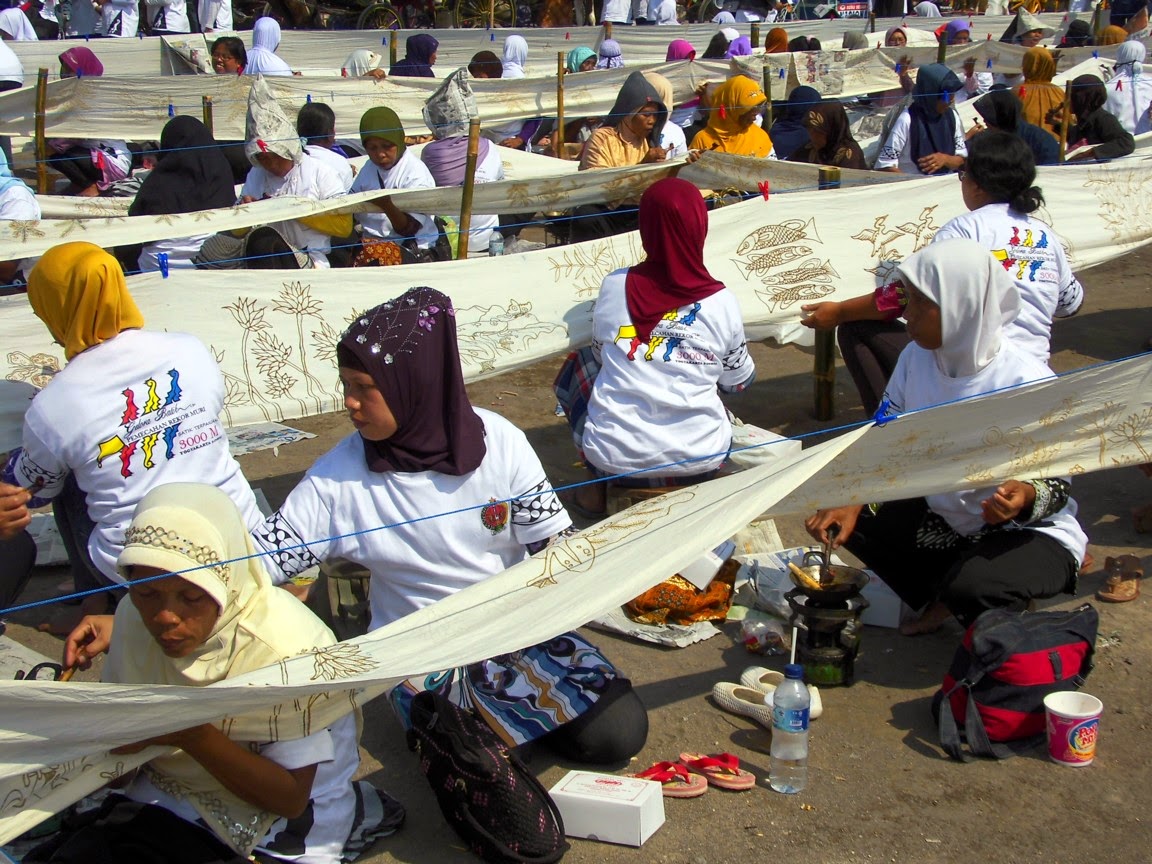
There was a world record giant batik production event. There was my night ascent of the 2911m Mt Merapi volcano. There were happy crowds of weekend domestic tourists on the beach and elsewhere. And there was the 'Idul Adha' Muslim Day of Sacrifice festival, where I was welcomed warmly.

Most of all there were friendly souls everywhere. What a wonderful place. What wonderful people. We probably don't deserve such good neighbours


I'll write up a few of my adventures in more detail over the next few posts.