Monday, 26 January 2015

India's Rubbish!

There's a lot of it these days, and it's not being disposed of thoughtfully. Indians traditionally just don't see litter. It's right in front of their noses, just like massive poverty and the caste system, but they can't see it.

A few years ago it would have all been biodegradeable, and it would have rotted, composted, or been harmlessly burnt. Now it's mostly paper and plastic, and it's everywhere.

There are heroic efforts being made to educate and to reform habits, probably more so in Kerala than any other state, but clearly there's more to be done.


Sunday, 25 January 2015

India's dog days numbered

Stray dogs are everywhere in India. They serve some purpose, traditionally, as scavengers and as guard dogs, but they can be a nuisance too, and they can spread rabies. Every now and again cities launch programmes to eradicate them, generally using inhumane methods.

I met a very interesting and personable chap in Trivandrum, who told me passionately about his work for the Humane Society International / India , whereby he and his team are eradicating dogs there humanely, by sterilising them, and at the same time educating the populace about not being afraid of them, and treating them better.

He was a vet by training, and hailed from Kashmir. (You start to wonder how many people are left in Kashmir - so many do you bump into in other parts of India.) His parents had been trying to lure him back there with talk of good safe jobs. He'd even been offered Australian residence, and knew he'd earn vastly more there if he took it up. But no, his passion was to travel India doing this sort of project, and his life was just fine as it was.

Saturday, 24 January 2015

Zoo of Pi

This is one of the tigers in Kerala's Trivandrum Zoo. It's name is probably not Richard Parker. But Richard Parker is the name of the tiger in the award-winning novel (and brilliant award-winning film), Life of Pi . If you haven't seen it, do.

Trivandrum Zoo is said to be the one that inspired the novel, in which the protagonist, Pi, was brought up in a small private zoo in South India. He later found himself drifting across an ocean with a tiger, a hyena, a zebra, and an orangutan for company. Eventually there's only the tiger (and Pi) left. The story explores ideas in epistemology, theology, ethics, the lot. And it's brilliant.


It was quite a good zoo by Asian standards. Some quite large enclosures, though some animals were rather too caged. I'll rephrase that. All cages are bad news, and in the case of the flying birds, they're outrageous. Zoos are probably not a good idea anyway, in this day and age. But lots of them, unfortunately, are worse than this one.

I kept finding that what was attracting my eye most (and my camera's too) were the animals of the human kind. So colourful are the people of India that I couldn't stop myself making them the subject of my pictures!

The poor caged white tiger was a sad but similarly photogenic subject though.

I watched the film for a second time on the flight home from India, and as is often the case with clever stories like this, I got a much better understanding of what it was all about.


Friday, 23 January 2015

Kerala wildlife


There were wild ones. There were tame ones. Some feathered, some tethered, and some that had just been untethered - and are loving it!


Wednesday, 21 January 2015

Pop go the licensing laws!

India has a complex array of liquor licensing laws. This partly reflects the diverse array of religious and political divisions around the place. So there are some hardline no-drug, no-alcohol philosophies, combined with the rather free-and-easy 'anything goes' attitude that actually makes everything work and everyone get on with each other (sort of).

In the state of Kerala recently, the rules have been changing almost from week to week. There's been a strong appetite among many local legislators for going down the prohibition road. They claim to have a particularly virulent problem with alcoholism, and judging by the scenes I witnessed when I passed by a couple of their licensed bottle shops, there must be something unusual going on. They were horrendous looking black holes, but with massive queues out along the pavement. Rather uninviting!

I'd had an indirect dealing with a Kerala bottle shop a few days earlier in Cochin. We'd arrived at our 4-star hotel after a long and thirsty day of travel. They had a rooftop restaurant and I was rather looking forward to a beer with my meal. No chance. You can't have alcohol with your meal, we were told. I was advised to wait in my room and all would be fixed. A good old standard Indian Kingfisher beer would be fine, I said. They couldn't quite guarantee that. They'd do what they could. Hungry and thirsty, I waited in the room, and after what seemed like an hour the stuff arrived. It was heavily camouflaged in brown paper packaging. It was warm. I was told I'd have to drink it in the room. Worst of all, it was Budweiser! And not the usual bland, sweet, weak, American Budweiser, but a special 8% proof one! Unheard of, and of course barely drinkable. It seemed the hotel had no liquor license, the chap had had to run to one of those dingy neighbourhood bottle shops, and the choice had been very limited!


In the beach resorts of Kovalam and Varkala, we found it all worked a bit better. It was quite clear that none of the restaurants or hotels had licences. They got around this by serving their beer in opaque pitchers, and encouraging you to keep the bottle on the floor, out of sight.


And the description of the beverage on the bill, in case of any audit by the licensing authorities? It was always either 'pop' or 'pop juice'!

Tuesday, 20 January 2015

Last orders at the Bangalore Club?

 The Bangalore Club is a fabulous historical relic of the British Raj era. It's still thriving, with a membership waiting list of 24 years, I think they told me. You can even inspect the records from Winston Churchill's time stationed here as a young military officer. He famously chatted up the barmaids and left without paying off his bar tab.

It's a rather magnificent place - immaculately maintained, full of dining and drinking facilities, beautiful grounds, sports facilities and special shops for members, including a bottle shop and wine bar they were rather proud of.

So we jumped at the chance of a visit and a lunch at the place, when it was offered. Our host, it turned out was even a committee member of the august establishment.

The visit was made particularly interesting by the drama which was playing out in the local papers at the time, and which I'd been reading about. A few weeks earlier, one of the club members, a government official, was refused permission to park his car on the grounds, and his membership suspended when he kicked up a fuss about it. He retaliated by pulling the relevant strings to have the licensing authorities swoop, and they found all kinds of alleged licensing violations. So after 147 years of unbroken traditions, the bars were suddenly closed. There was no alcohol being served with meals, and the prized bottle shop was taped shut. More on this at: http://indianexpress.com/article/india/india-others/bangalore-club-loses-liquor-licence-for-now/

Our host was very apologetic about all this, and he spent most of the time on the phone or in little huddles with staff and other committee members, discussing the situation. It had become rather complicated, we understood, with senior government ministers and several bureaucracies now involved! We had a good time anyway, and a thoroughly delicious non-alcoholic lunch.

The last time I checked, things were looking up again. A compromise had been worked out. The problem member had been reinstated, and the Men's Bar at least, was to be reopened. See http://www.bangaloremirror.com/bangalore/others/Its-cheers-at-the-Blore-Club/articleshow/45634381.cms?


Monday, 19 January 2015

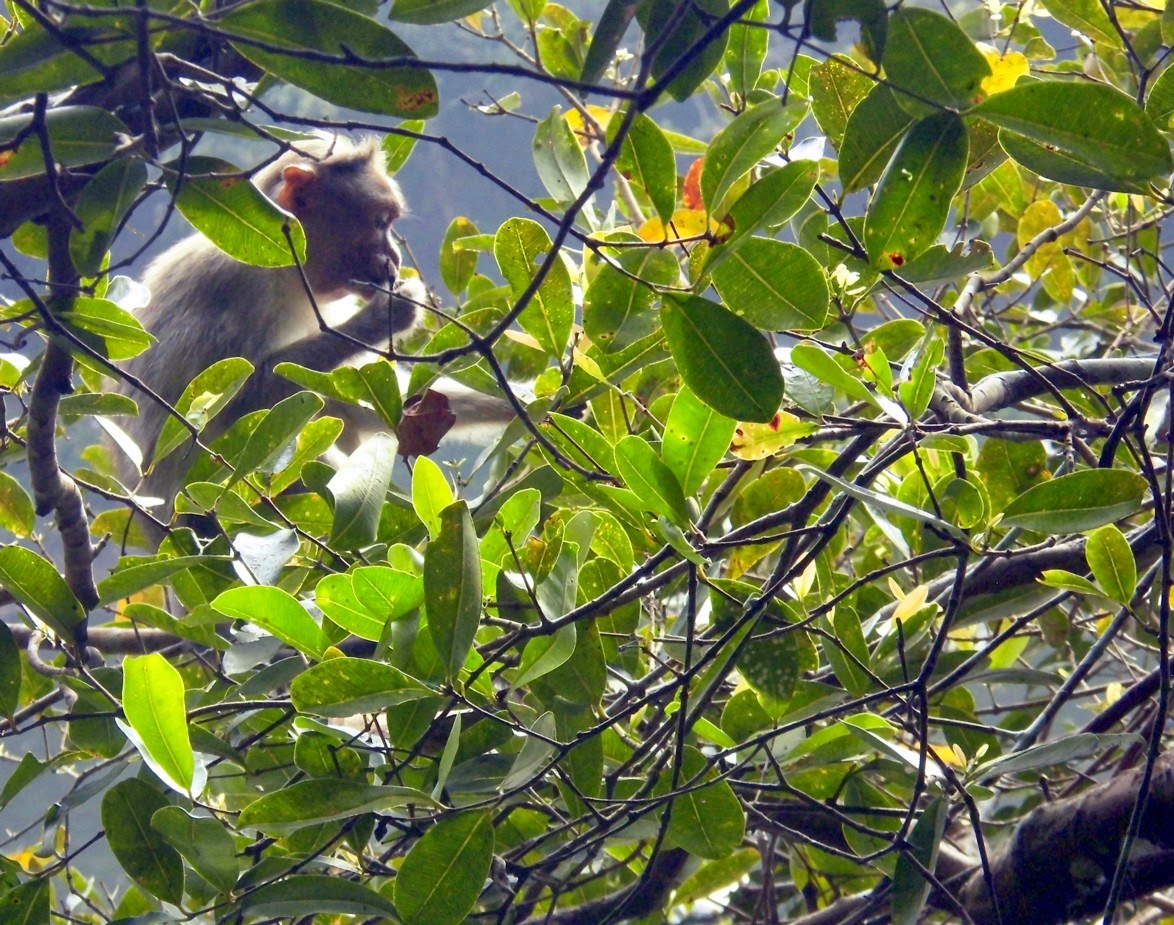
Monkey business


Monkeys are everywhere in India. Don't get too close and they'll leave you alone.


They're usually far too busy reading the newspaper, after all. This one is at the Sri Chamundeswari temple on Chamundi Hill.


Or checking each other out, sometimes rather too closely.