Wednesday, 22 October 2014

Searching for Sembungan

One of the things to do while visiting the Dieng Plateau in Central Java is to wander up the road from Dieng Village, to the highest village in Java: Sembungan (2300m). From there you continue a little further, and climb the mini volcano, Gunung Sikunir (another 100m or so to the top).

I was wanting a bit of volcano-climbing practice before attempting the real one - Merapi -and if there's a Java's highest village to knock off along the way, then that's fine with me.

Lonely Planet said it was a kilometre and a half from Dieng village to the Coloured Lake, and a further kilometre and a half to Sembungan. It said nothing about any other villages in between. Well that latter distance turned out to be all wrong. It was three or four kilometres at least, and there were two other villages along the way which The Book made no mention of. So I kept coming into yet another 'Java's highest village', photographing it, and continuing
upwards. One of these was this one, with the usual quota of very friendly residents and a stack of irrigation pipes spanning the roadway to service their potato fields.

Another was the one I strolled through while the noon call-to-prayer was playing from its one mosque and two prayer halls. A magnificently atmospheric experience.

Eventually I came upon the real Sambungan (pictured at top, with little Sikunir behind it). It was full of magnificently friendly folk, some very keen to ham it up for my camera!


Most domestic tourists who climb Sikunir, do it to the usual pre-dawn timetable, for the sunrise view. It's not much of an ascent, but a big deal seems to be made of it, with a sign at the base telling you all about the things you need to do and take with you! I must admit, I'd even forgotten my drinking water this time. But what with the cool climate and the rather undemanding little climb, I somehow made it back unscathed!

Sunday, 19 October 2014

Potatoes maketh the mosque

After a few days in Solo, I headed up into the hills for a cool climate respite. To Central Java's Dieng Plateau, to be precise. It's a few hours by bus north west of Yogyakarta, and it's about 2000m above sea level.


Because of the cooler climate, the Dieng Plateau is ideal for growing several crops that don't come easily in most of Indonesia. Potatoes especially. They also grow cabbages, onions, and a South American fruit - carica - that I'd not heard of before, but which all the domestic tourists buy up as souvenirs.


It seems the Dieng Plateau has done extremely well from its cool climate crops. A measure of a region's prosperity is the state of its mosques, and Dieng village's new one is something to behold. That's a rather beautiful little mosque!

The crops are heavily irrigated and often grown on beautiful terraced hillsides. The workers are all extraordinarily friendly and welcoming of my photography. When I got temporarily lost in a cabbage patch, I was soon rescued by a group of friendly cabbage patch ladies, who sent me off in the right direction again.


Friday, 17 October 2014

Solo pursuits 2: Java Man

A few kilometres north of Solo is the village of Sangiran. It's here that the best specimens of Java Man remains were discovered in the late 19th century, and it's here they've built a museum about him.

Java Man was hailed as one of the 'missing link' species, bolstering support for Darwin's recently published evolution theory. Examples have been dated at nearly 2 million years to about 140 thousand years before the present, and found subsequently in lots of places around the world.

The Sangiran museum has a lot of  educational stuff about evolution generally, as well as documenting and housing some of the local finds. It also has a few references to Homo floresiensis, 'yang sangat problematis' ('which is highly problematic'). The problem, as I understand it, is that while almost all the world's archeologists consider the 'Hobbit' to be a distinct species of tiny hominid which survived on Flores until fairly recently, this was hotly contested by the top Indonesian paleoanthropologist. Teuku Jacob is dead now, so his name can be blackened. He's said (by the foreigners at least) to have stolen the exhibits, damaged a valuable specimen, and had the cave where it was found blocked off so he couldn't be proved wrong. My Indonesian isn't good enough to work out what the Java Man museum's official line is on the controversy.

I got to Sangiran very easily by public bus and motorcycle pillion taxi, and spent a comfortable hour or two wandering through the galleries, enjoying the airconditioned respite from the heat outside.

Homo erectus (Java Man) is the third from the left on their illustration below.


Tuesday, 14 October 2014

Solo pursuits 1: bicycles & cottage industries

Central Java's Solo City, known also as Surakarta, competes with Jogja, known also as Yogyakarta, as the pre-eminent centre of Javanese culture. Jogja is better known and much more heavily touristed, but Solo, with half a million people, is actually slightly bigger, and it's a more relaxing place to be.


What does a visitor to Solo do? There are temples and palaces to visit, dances and puppet shows to watch, and then there's the famous bicycle tours to do.

The best known bicycle tour is organised through the Warung Baru homestay, and involves cycling through the padi fields of the nearby countryside, and visiting several interesting little establishments.
There's a bakery, an arak (rice spirit) distillery, a rice cracker factory, and the inevitable batik fabric establishment. But the most spectacular of the photo-op stops was the blacksmith's workshop, the 'gamelan factory', where the huge gamelan gongs are forged and beaten into shape in a dark shed among sparks and flames by barefoot craftsmen with only plywood and palm leaves for eye protection. A gamelan gong machine consists of many different sized gongs, and this workshop's target is one complete instrument per day.

 At the end of our ride, our guide, the very entrepreneurial but highly personable Dodi, took us to the best gado-gado stall in Solo for lunch. The lady took our various orders (varying degrees of chilli hot, eggs or not, which vegetables). She then ground the peanuts with mortar and pestle to make our individualised sauces, and dished up the lot within minutes. And it was indeed delicious. (As was just about all the street food I sampled during my trip.)

Saturday, 11 October 2014

Climbing the Mountain of Fire

Central Java's Mt Merapi is one of the most active volcanoes in the world. It has erupted several times in the last few years, and it often looks like it does on the poster I saw, probably depicting the situation four years ago. I even remember peering at it from a safe distance on a visit to Yogyakarta nearly three decades ago, and it looked like the poster then too!

When planning my Central Java trip the Merapi climb was the one thing I told everyone I was determined to do. So climb it I did. I found all the organised tours insisted that you do the night climb, ready for the view of the sunrise from the top. They pick you up from Jogja at 10pm, drive you to Selo village, give you a cup of coffee, a torch, and some guides, and up you go. I spent a day or two looking for someone who would do it to a slightly later timetable, thus allowing a bit of beauty sleep beforehand. They were all insistent though, that the standard timetable was the one to do.

It's a very steep and steady slog, ascending from 1500m to 2900m in four hours. Somehow the sleepless night wasn't a problem. The loose and slippery surfaces were though. We all slip-slided our way up in the volcanic dust, scree and sharp rocks, and it was like doing double the ascent. There were four rest stops along the way, and at one of them, just below the tree line, the guides lit a morale boosting fire to warm us and dry our sweaty backs.

At one of the seismic monitoring stations, one of the guides tried to contact the seismic HQ people for an up-to-date activity report, but couldn't get through. We can proceed anyway, he announced, "but careful". He told us later that he was seeing more sulphurous gas than usual coming out of the various fumeroles around the place, and he wasn't keen on spending longer up there than necessary.

We made it to the top with a few minutes to spare, and the views were magnificent - before, during, and after the sunrise. You perch on the knife edge of the crater below, and try not to move too quickly or pass too close to a fellow trekker in case you're accidently despatched. There's an amazing moonscape around you, and a new summit that you don't actually try to conquer. I gather that it appeared during the 2010 eruption, and increased the height of the mountain by 38m. Just to the north there's the spectacular Merbabu volcano, and looking either east or west you see a whole string of volcanoes peeking out of the cloud layer - the chain that forms the spine of this most volcanic island in the world.

Going down takes two hours only! That's because you can see where you're going, and because in the scree sections at least, it's almost impossible not to run! There were of course cuts, torn clothes, and at least one ankle sprain. The guides agreed that they do in fact have serious injuries too, and do get to take people to hospital sometimes.
Breakfasted in Selo, and back in Jogja by midday, I felt good about my Fire Mountain experience.

Wednesday, 8 October 2014

Wanna see my slides? - I've been to Java too!


And what a trip it was. I went to Central Java, specifically Solo City, the Dieng Plateau, and Yogyakarta (Jogja), to fill in a missing link in my Indonesia travels.
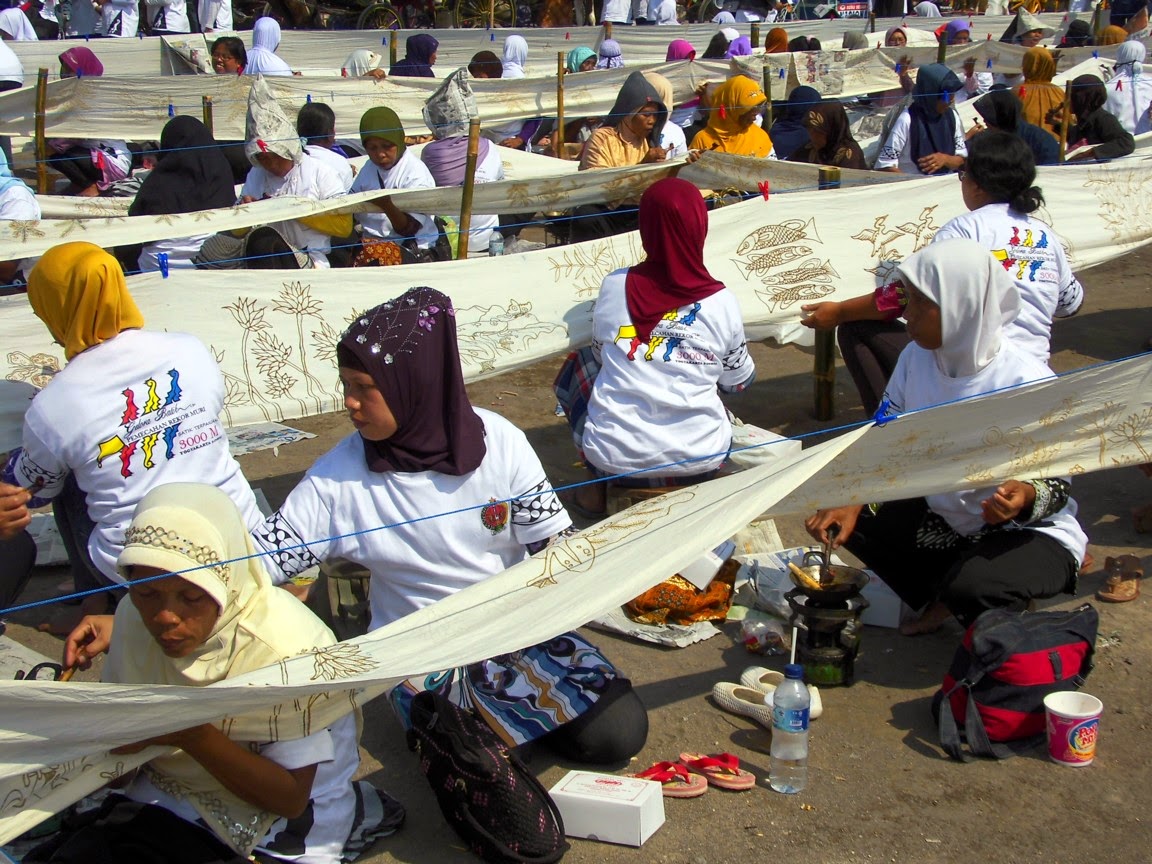
There were sultans' palaces, bicycle tours of the padi fields, a gamelan foundry, bird markets and countless other market scenes. There were the ancient Hindu temples at Prambanan, volcanic bubbling lakes, brightly painted mosques galore, and joyous festivals, marches, and gatherings of all kinds.

There was a world record giant batik production event. There was my night ascent of the 2911m Mt Merapi volcano. There were happy crowds of weekend domestic tourists on the beach and elsewhere. And there was the 'Idul Adha' Muslim Day of Sacrifice festival, where I was welcomed warmly.

Most of all there were friendly souls everywhere. What a wonderful place. What wonderful people. We probably don't deserve such good neighbours


I'll write up a few of my adventures in more detail over the next few posts.