Thursday, 7 August 2014

West Head tracks and treasures

I'm leading a bushwalk soon along a selection of the tracks and fire trails that lead out on either side of the West Head Road in the Ku-ring-gai Chase National Park. So I did a quick recce the other day, to remind me what was what and which tracks would best suit for a 25 km total walk and a mix of experiences.


I settled on the following itinerary: the Waratah Track, the Willunga Track, the Bairne Track, and the circuit walk formed by the West Head, Headland, and Resolute tracks. Between them they provide some nice long leg stretches, some great water views in all directions, the chance of wildlife sightings, and a good selection of aboriginal artworks. I stumbled on several examples of rock engravings that I'd been completely unaware of before. National Parks deliberately only signpost a few of the more accessible ones, but if you keep your eyes open and explore the many flat rocky areas you come to, there are lots more to be seen. There was a 'Red Hands Cave' too, close to the much touristed West Head. I'd been unaware of this one, but it was in fact one of the signposted attractions.

A frequent highlight for me of walks around here is the sighting of a snake or two. In particular a beautiful diamond python will often be stretched out and sunning itself across the fire trail. No such luck this time. Although it's been an unusually warm and sunny winter, it's still not quite warm enough to lure them out of their seasonal slumber. Won't be long now. And it won't be long before we can start looking for the Waratah flowers. There was lots of birdlife around, though no sea eagles soaring above on this occasion. But there was a very cocky brush turkey hanging around Red Hands Cave.

I think I've put together a good little day's outing for the bushwalkers.

Saturday, 2 August 2014

Once were leafy green


The 'leafy green northern suburbs' are a bit of a Sydney cliche. But as you fly over Sydney that is indeed what you see: an urban forest with houses and roads and things tucked away underneath. We're rather proud of it, though we do accept there are penalties to be paid in terms of increased fire danger and inconvenience from time to time through interrupted power supplies or traffic hazards. And the odd house gets damaged from time to time, and occasionally - very occasionally - someone does indeed get squashed.

Suddenly the delicate balance between the pro-tree and anti-tree forces seem to be shifting rapidly. There was the shock of the Blue Mountains bushfires late last year. There has been a relaxation of the rules about permitted tree clearing around houses in rural areas. There was the tragic death in Pitt Town Public School's playground a few months ago. There was the election a couple of years ago of an extraordinarily pro-development Hornsby Council. And along the Northern Line railway corridor between Epping and Thornleigh, there has been a 'treemageddon' going on, as huge numbers of mature healthy trees have been removed to make way for a third railway track to speed up goods trains.

Perhaps it was entirely appropriate therefore that my progress to my morning coffee break in Pennant Hills last Saturday was unexpectedly blocked by what was described in a local paper as a 'tree chopping frenzy'. It was the day before National Tree Day, would you believe, and two huge and well loved blue gums were being dispatched.


A week later, and the scene of the crime is marked by floral memorials to those obviously much loved trees. I watched through the cafe window though, as a Hornsby Council worker, disguised as a sulphur crested cockatoo, dismantled even these.


For more on this (and better pictures, though I say so myself), see: http://www.dailytelegraph.com.au/newslocal/the-hills/hornsby-council-accused-of-tree-chopping-frenzy-as-it-fells-two-mature-blue-gum-trees-at-pennant-hills/story-fngr8i1f-1227004202507


Sunday, 27 July 2014

Parramatta's pre-eminent park


Parramatta Park is about history. It's about spaciousness and leisure activities. It's about fruit bats, the upper extremity of the Parramatta River, monuments and historical relics galore. There's lots of cricket getting played, usually by Parramatta's Indian population, there are rock concerts and orchestral ones, and there's Old Government House - the oldest surviving public building in Australia. Then there's the site of the first farm, the one that saved the early European settlers from an early starvation. There's the remains of an astronomical observatory, and there's lots more. I could go on, but I won't. It's a top park. Check it out if you haven't yet.

Monday, 21 July 2014

Lesser known museums No.138: Nicholson Museum

Just along the road and across the main quadrangle from the Macleay Museum, is Sydney University's other little gem museum - the Nicholson.

I forgot all about it while I was at the Macleay the other week, so headed back on Friday to make amends. While the Macleay Museum is about natural history, the Nicholson is about

antiquities. Very manageably sized collections of antiquities from ancient Greece, Cyprus, Egypt, Italy, and the 'Near East' (including Mesopotamia, Pakistan and India).

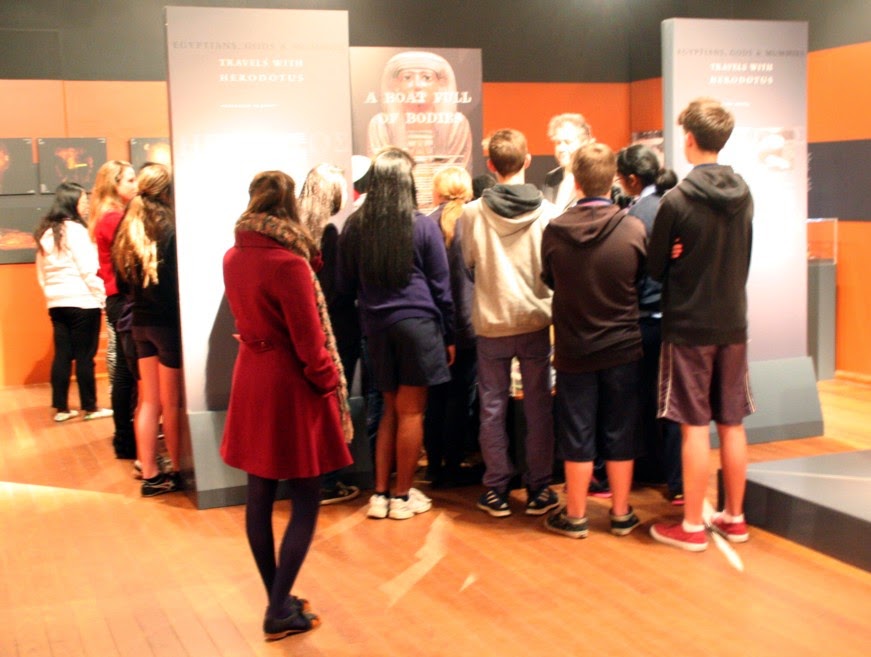
I liked the Egyptian mummies of course. They've got three human ones, and X rays or CT scans or something of one of them, and they've also got mummified cats, birds, and crocodiles, would you believe. The section was about Egypt as seen through the eyes of Greek travel writer Heroditus, in 450BC. As well as putting all those early pyramid reviews on TripAdvisor, he busied himself recording recipes for mummification. Feel free to try it out for yourselves, but stand well to the side when you pull out the plug. Hopefully the kids in the school group (or ancient history & mummification tutorial group?) will take all necessary precautions.


A well promoted attraction in the Greek section was the Lego Acropolis. That seemed to have been removed or dismantled when I got there though. Never mind, the 1895 plaster one was there, and it's not a bad Acropolis at all.

Tuesday, 15 July 2014

Mt Annan Botanic Gardens

I'd been there once before, about ten years ago when it was a fairly new creation. Since then the Mt Annan Botanic Gardens have grown up and matured nicely. I found lots of nice little (and not so little) features to admire and explore.

It's near Camden, to the south west of Sydney, and it's 416 hectares in area, and Australia's larget botanic garden. It's run by the same Royal Botanic Gardens & Domain Trust that runs the main Sydney one and the Blue Mountains version at Mt Tomah. Mt Annan's specialty is the display of 'plants from across Australia in both formal and informal settings within a typically Australian landscape'.


There are sculptures, barbecue areas, sundials, picnic areas, a visitor centre, a blue tree, and a cafe. There's a memorial to the aboriginal stolen generation, and there's the Australian Plantbank, which hosts one of the largest native seedbank collections in the world.

There are also lots of Wollemi pines, the 'living fossil from the dinosaur age'. It had been thought to have been extinct for eons, but was found in 1994 in one steep sided valley in the depths of the Wollemi National Park. It's been planted all over the place now, and seems to be rather a happy and hardy species.

And I loved the Sturt's Desert Peas, from central Australia. Bright red, in full flower, and not seemingly worried to be so far from home.


Mt Annan (the mountain itself) is actually a bit of a molehill. I strolled up it, and you do get nice views of the rest of the site, but a rather drab view of the surrounding monocrome grey suburbs.

I might come back more frequently in future.

Wednesday, 9 July 2014

Lesser known museums No. 137: the Macleay Museum

Sydney's full of funny little niche museums. For example, there's the Army Artillery Museum, the Scout Museum, the Tennis Museum, Fort Denison, Hyde Park Barracks, the Justice and Police Museum, the Museum of Australian Currency Notes, the Museum of Freemasonry, the Susannah Place Museum, the Bus Museum, the Harbour Bridge Museum, the Jewish Museum, the Sydney Mint, Sydney Observatory, the Tramway Museum, and the White Rabbit Gallery, to name but a few.


Two such examples are located at Sydney University. There's the Nicholson Museum ('largest collection of antiquities in the southern hemisphere'), and there's the Macleay Museum, which I popped into last week for the first time.


This one is all about natural history, but it's also part of our history. It's got enormous collections of all sorts of things, many dating from before Australia's European settlement. Especially insects, but also mammals (including a Tasmanian Tiger skeleton), ethnography (New Guinea mainly), historic photographs, and scientific instruments (including the University's first primitive computer). Most of the collection, especially the most fragile historic things, are kept deep in the bowels of the building somewhere, but the nicely sized gallery that's open to the public has a beautifully traditional museum-like feel to it, and a sufficient collection of all this stuff to keep you enthralled for a good hour or two.


 The story of the Macleay family is quite interesting. Alexander Macleay was the Colonial Secretary in the early 19th century, and was a prolific gentleman collector who brought his enormous collection with him. Two subsequent generations of Macleays kept up the tradition, did useful work in classification, met Charles Darwin, the lot. When the collection outgrew their house (the fine Elizabeth Bay House - a heritage house and museum in its own right, which I've yet to visit), they donated it all to the university.


Friday, 4 July 2014

Sydney Uni: Graffiti & gravitas


Sydney University does a good line in graffiti. They even have a famous and well signposted graffiti tunnel, to highlight this particular academic specialty.


But it's not the whole story. Sydney Uni is indeed Australia's oldest University, and is within Australia considered a solid and prestigious institution. How well regarded is it by world standards? Well, it is, sort of. According to the Times Higher Education World University Reputation Rankings for 2014, it's right up there in the 61-70 band, down a bit from 49th last year, and sadly a bit behind Melbourne University and the Australian National University in Canberra. (Harvard University comes in at No.1 again, and I can't resist mentioning Imperial College London still being up there at No.13)

Sydney Uni does have a lovely old campus, well located and with fine buildings, old and new. It has got a beautiful feel to it, especially on perfect blue sky days like today. It's got an excellent outreach programme, with all kinds of fabulous talks and other events which the public are invited to attend. And, if you believe the local media at least, it does churn out lots of useful research results, as well as lots of doctors, engineers, lawyers etc.

Like most Australian tertiary education institutions, it's got awfully interested in recent years in the education business, as opposed perhaps to the business of educating people, and the campus is full of high fee paying overseas students. I watched a little post-graduating ceremony photo shoot, where the group got their instructions on the throwing-your-mortar-boards-into-the-air routine, watched by their proud parents, over from China.

Some things haven't changed though since my student days. Still seems to be lots of politics, lots of meetings, lots of notices and graffiti. Maybe the overseas students aren't pulling their weight in that department, but maybe, just maybe, they'll learn something from it, and their time here will have been worthwhile.